GoMRI eNews · Oct 1, 2019 · ← All issues
Welcome to the GoMRI eNews.

Keeping you current on emerging Gulf science and the people investigating the effects of oil spills on the environment and public health.

October 1, 2019                                                                    GoMRI eNews

Stories

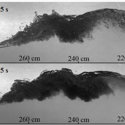
Study Quantifies Dispersant Effects on Initial Oil Slick Breakup by Waves

Attention Oil Spill Researchers! IOSC 2020 Scholarship Applications Now Being Accepted

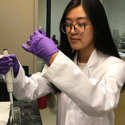
Grad Student Deng Investigates How Marine Microbes Move When Oil is Present

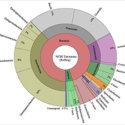
Study Quantifies Limitations in Using Marker Genes to Predict Microbial Capabilities
Scientists conducted the largest comparison to-date of publicly available sequenced bacterial genomes to provide the first in-depth look at using high-throughput marker genes to profile a microbial community’s functional capability.

From the Archives

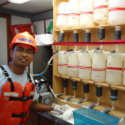
Grad Student Viamonte Puts Pressure on Microbial Oil Degradation

Posted on September 27, 2018
When the Deepwater Horizon incident occurred, not much was known about how conditions in the deep sea would affect oil biodegradation. Juan Viamonte uses high-pressure reactors that simulate conditions at depth to observe microbial degradation and help predict what might happen should another deep-ocean oil spill occur.

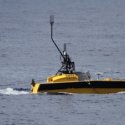
Study Describes How Autonomous Surface Vehicles Improve Marine Mammal Monitoring

Posted on September 28, 2017
Scientists conducted passive acoustic monitoring (PAM) of whales in the northern Gulf of Mexico using two autonomous surface vehicles (ASVs) capable of recording marine mammal sounds.

Study Finds Natural Sunlight Affects Oil-Degrading Bacteria Composition and Dynamics

Posted on September 27, 2016
Scientists from the University of Texas Marine Science Institute demonstrated how natural sunlight affects Gulf of Mexico microbial communities in the presence of Corexit (dispersant) and crude oil. They observed that sunlight significantly reduced the diversity of bacterial communities in the presence of oil, Corexit, or both.

Publications

Study Recommends Eight Stress-Reducing Actions to Improve Disaster Resiliency
Enhancing disaster resilience by reducing stress-associated health impacts. Sandifer, P.; Walker, A.H. Frontiers in Public Health, December 2018, Volume 6, Article 373

Study Details How Oil Exposure Affects Marsh Predator-Prey Interactions
The effects of oil on blue crab and periwinkle snail interactions: A mesocosm study. Robinson, E.M.; Rabalais, N.N. Journal of Experimental Marine Biology and Ecology, Volume 517, August 2019, Pages 34-39

Data

Dataset for: Characterization of the microbiome and bioluminescent symbionts across life stages of ceratioid anglerfishes of the Gulf of Mexico -- data link

Dataset for: Marker genes as predictors of shared genomic function -- data link

Microcosm study: Photochemical oxidation of crude oil -- data link

Announcements

Registration Open for 2020 Gulf of Mexico Oil Spill & Ecosystem Science Conference
The full conference registration fee covers entry to all conference activities, including workshops, breaks, and breakfast. Attendees who stay at the Tampa Marriott Water Street (the conference venue) will receive a discount on registration. When registering for the conference, please enter your hotel confirmation number to receive the discount. Click here to make a reservation at the Marriott.
  • Early Bird (on or before November 30, 2019) - $550 ($450 with conference hotel reservation).
  • Regular (after November 30) - $650. ($550 with conference hotel reservation).
  • Student - $300. ($250 with conference hotel reservation).
  • One-day Early (on or before November 30) - $250 (no hotel reservation required).
  • One-day Regular (after November 30) - $300 (no hotel reservation required).
  • Workshop-Only - $250 (attendance only at a workshop and not any part of the conference).
  • Onsite registration will be available subject to a $50 late fee

Project Activities

ADDOMEx and DROPPS Collaborate on EPS Research
Researchers from both consortia are contributing to a joint effort to understand how the protein-carbohydrate ratio of an exopolymeric substance (EPS) affects its aggregate formation with oil and other particles. For this collaboration, researchers at Texas A&M University Galveston extract and purify EPS that is then sent to Texas A&M University-Corpus Christi researchers for microfluidics experiments.
 
RECOVER Researcher Featured on GulfCast Podcast
Dr. Claire Paris from the University of Miami Rosenstiel School of Marine and Atmospheric Science recently featured on the Dispatches from the Gulf podcast to discuss how dispersants affect the Gulf of Mexico ecosystem and resulting impacts from the Deepwater Horizon event. Listen to the episode here.