|
|
|
|
July 23, 2019 GoMRI eNews
|
|
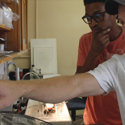
Researchers conducted swim tests on Gulf of Mexico Cobia fish to investigate potential impacts from oil exposure.
|
|
|
The Gulf of Mexico Research Initiative (GoMRI) congratulates Dr. Joel Kostka on his election as a 2019 American Academy of Microbiology (AAM) Fellow.
|
|
|
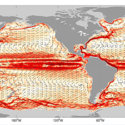
Scientists developed a new approach to improve near-surface (15 meters depth) ocean circulation estimations derived from drogued and undrogued drifters (drogues extend below the surface, providing stability) used in the NOAA Global Drifter Program.
|
|
|
Posted on July 12, 2018
The deep-pelagic habitat (200 m depth to just above the seabed) is the largest habitat in the Gulf of Mexico, yet we know very little about it compared to coastal and shallow-water habitats.
|
|
|
Posted on July 20, 2017
Gulf-wide baseline for oil pollution monitoring complete! Marine scientists advanced academic relations between the U.S. and Cuba during an 18-day research expedition (May 8-25) off the northwest coast of the island nation.
|
|
|
Posted on July 20, 2016
Scientists conducted a meta-analysis of Gulf of Mexico fiddler crab data across multiple years, sites, and studies to examine if the Deepwater Horizon oil spill impacted the crabs’ size, abundance, and population composition.
|
|
|
Study Uses Ramped Pyrolysis Oxidation to Assess Oil Spill Material Evolution on the Seafloor
Petrocarbon evolution: Ramped pyrolysis/oxidation and isotopic studies of contaminated oil sediments from the Deepwater Horizon oil spill in the Gulf of Mexico. Rogers, K.L.; Bosman, S.H.; Lardie-Gaylord, M.; McNichol, A.; Rosenheim, B.E.; Montoya, J.P.; Chanton, J.P.; Cooper, L.W. PLoS ONE 14(2): e0212433
Study Presents 1st Continuous Profile of Marine Snow Distribution from the Surface to Near Seafloor
Vertical marine snow distribution in the stratified, hypersaline, and anoxic Orca Basin (Gulf of Mexico). Diercks, A.; Ziervogel, K.; Sibert, R.; Joye, S.B.; Asper, V.; Montoya, J.P. Elementa Science of the Anthropocene, 7(1), p.10
|
|
Observations of the developmental stages of Mahi-Mahi (Coryphaena hippurus) -- data link
Dataset for: Deepwater Horizon crude oil exposure alters cholesterol biosynthesis with implications for developmental cardiotoxicity in larval mahi-mahi (Coryphaena hippurus) -- data link
Understanding resilience attributes for children, youth, and communities in the wake of the Deepwater Horizon oil spill study, social media component -- data link
|
|
August 13 Sea Grant Oil Spill Seminar on Overlooked Species
Learn about species that media often overlook during a spill and those species' potential roles in guiding restoration efforts. Speakers include Patrick Schwinn (foraminifera), Frank Hernandez (zooplankton & ichthyoplankton), Kayla Kimmel and Barret Fortier (sturgeon, alligator gar, fur-bearers, vegetation), Scott Zengel (fiddler crabs, marsh periwinkle), Linda Hooper-Bùi (insects, spiders), and Michael Polito (marsh food webs). The seminar will be held at the Southeast Louisiana National Wildlife Refuges Complex in Lacombe, Louisiana. Click here to register and attend in person. Click here to join the webinar online.
|
|
|
|
|
|
|