|
|
|
|
March 5, 2019 GoMRI eNews
|
|
The Gulf of Mexico Research Initiative (GoMRI) congratulates Dr. Joseph Katz on his election to the National Academy of Engineering 2019 class, one of the highest professional distinctions accorded to an engineer.
|
|
|
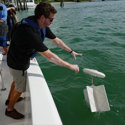
Many ocean forecast models treat the upper 1 meter of the water column, which plays a central role in ocean material transport, as a single layer. However, recent research shows that currents act differently at various depths within this meter.
|
|
|
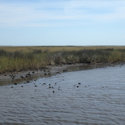
Researchers conducted mesocosm experiments that examined how juvenile eastern oysters respond to salinity variations in the presence of oil and dispersed oil.
|
|
|
Posted on February 20, 2018
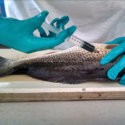
Researchers analyzed the metabolic capability of three Gulf of Mexico fish species after being exposed to toxic polycyclic aromatic hydrocarbon (PAH) compounds. Florida pompano exhibited faster biotransformation rates for hydroxylated naphthalene and phenanthrene compounds than red drum and southern flounder.
|
|
|
Posted on February 21, 2017
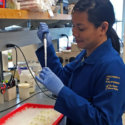
Polycyclic aromatic hydrocarbons (PAHs) can disrupt important signaling pathways that transcribe genes during fish’s early embryonic development, which could cause malformations.
|
|
|
Posted on February 16, 2016
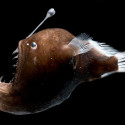
DEEPEND expands knowledge as a restoration tool for the Gulf’s largest ecosystem. Much uncertainty remains about impacts on the deep-sea environment from the 2010 oil spill that erupted more than 5,000 feet below the sea surface. However, knowing what was affected or what may change in the future is particularly difficult with little to no pre-existing knowledge about this obscure ecosystem. Environmental impact assessments of an area require some baseline of what lives and happens there.
|
|
|
Study Uses Pyrolysis-GC-MS to Quantify Overall Degree of Oil Weathering
Environmental petroleum pollution analysis using ramped pyrolysis-gas chromatography-mass spectrometry. Seeley, M.E.; Wang, Q.; Bacosa, H.; Rosenheim, B.E.; Liu, Z. Organic Geochemistry, Volume 124, October 2018, Pages 180-189
Study Uses Next-Generation Sequencing to Show Corals' Cellular Stress Responses to Oil and Dispersants
Gene expression profiling reveals deep-sea coral response to the Deepwater Horizon oil spill. DeLeo, D.M.; Herrera, S.; Lengyel, S.D.; Quattrini, A.M.; Kulathinal, R.J.; Cordes, E.E.
|
|
Dataset for: Oil biodegradation: Interactions of artificial marine snow, clay particles, oil, and Corexit -- data link
Bulk density/porewater data from sediment cores collected onboard R/V Weatherbird II cruise WB-0915 and R/V Justo Sierra cruise JS-0815 in the southern Gulf of Mexico from 2015-07-30 to 2015-09-29 -- data link
Bulk density and porewater data collected onboard R/V Weatherbird II cruise WB-0816 and field expeditions in the Gulf of Mexico from 2016-08-05 to 2016-09-09 -- data link
|
|
Survey for 2019 Gulf of Mexico Oil Spill and Ecosystem Science Conference
If you attended the conference, please check your email for a survey. Your feedback will help in planning GoMOSES 2020 and future Gulf of Mexico science conferences.
March 29 and April 5: Regional Priority-Setting for Health, Social, and Economic Disruption from Spills Workshops.This public health series is hosted by the National Academies, GoMRI, and Sea Grant. The meeting in Virginia Beach, Virginia will be on March 29 and in Santa Barbara, California on April 5. Learn more here.
|
|
CSOMIO Researchers Participate in Open House
Researchers Eric Chassignet, Dmitry Dukhovskoy, and Taylor Shropshire participated in the Florida State University Center for Ocean-Atmospheric Prediction Studies (COAPS) open house to help explain the importance of models in scientific research. View photos from the event here.
RECOVER Tuesday Tool Profile Features Fluorescence
University of North Texas Ph.D. student Rachel Leads uses dyes or proteins that when hit with high-intensity light from a fluorescent microscope to observe changes in molecular processes and structures. See how she uses this technique to investigate how sunlight and UV radiation impact the toxicity of oil spill chemicals in red drum here.
|
|
|
|
|
|
|