|
|
|
|
February 19, 2019 GoMRI eNews
|
|
Researchers conducted mesocosm experiments that examined how juvenile eastern oysters respond to salinity variations in the presence of oil and dispersed oil.
|
|
|
The Gulf of Mexico Research Initiative (GoMRI) congratulates its Research Board member Dr. Peter G. Brewer on receiving the China International Science and Technology Cooperation Award, the highest honor China bestows on a foreign scientist for important contributions to China's science and technology development.
|
|
|
Scientists completed the first time-series study (2007-2016) of Gulf of Mexico deep-sea fishes and their exposure to polycyclic aromatic hydrocarbons (PAHs) following Deepwater Horizon.
|
|
|
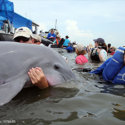
A dedicated research team of over 50 specialists from academia, non-profit organizations, animal care providers, and the National Oceanic and Atmospheric Administration (NOAA) are continuing the assessment of Gulf of Mexico dolphins to learn how the 2010 oil spill affected these vulnerable marine mammals.
|
|
|
Posted on January 16, 2018
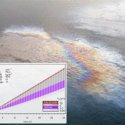
Researchers developed an algorithm that accounts for different wind speeds, oil types, natural dispersion processes (breaking waves), and chemical dispersant application to analyze oil slick evolution scenarios. The model results indicate how the oil slick will become thinner and dissipate over time as a result of dispersion.
|
|
|
Posted on February 16, 2017
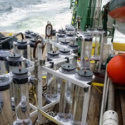
Researchers measured polycyclic aromatic hydrocarbon (PAH) concentrations in water collected near the Deepwater Horizon site to understand how sinking particles, such as marine snow, influence the residence time of PAHs in the upper ocean.
|
|
|
Posted on February 9, 2016
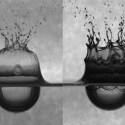
Scientists at Johns Hopkins University used high-speed imaging and digital holography in laboratory experiments to investigate the effects of raindrops falling on a simulated oil slick.
|
|
|
Study Shows Microbial Secretions More Efficient than Corexit in Promoting Tiny Aggregate Formation
Protein: Polysaccharide ratio in exopolymeric substances controlling the surface tension of seawater in the presence or absence of surrogate Macondo oil with and without Corexit. Schwehr, K.A.; Xu, C.; Chiu, M.-H.; Zhang, S.; Sun, L.; Lin, P.; Beaver, M.; Jackson, C.; Agueda, O.; Bergen, C.; Chin, W.-C.; Quigg, A.; Santschi, P.H. Marine Chemistry, Volume 206, 20 October 2018, Pages 84-92
Study Reports Recovery of Horse Fly Population Five Years After Deepwater Horizon
Recovery of horse fly populations in Louisiana marshes following the Deepwater Horizon oil spill. Husseneder, C.; Park, J.-S.; Foil, L.D. Scientific Reports, volume 8, Article number: 13777 (2018)
|
|
Bulk density/porewater data from sediment cores collected onboard R/V Weatherbird II cruise WB-0814 in the Gulf of Mexico from 2014-08-14 to 2014-08-28 -- data link
Bulk density/porewater data from sediment cores collected onboard R/V Weatherbird II cruises WB-0815 and WB-0915 in the Gulf of Mexico from 2015-08-16 to 2015-10-01 -- data link
Seaside Sparrow nest success on oiled and unoiled plots in Barataria Bay, Louisiana from 2017-03-27 to 2017-07-01 -- data link
|
|
Survey for 2019 Gulf of Mexico Oil Spill and Ecosystem Science Conference
If you attended the conference, please check your email for a survey. Your feedback will help in planning GoMOSES 2020 and future Gulf of Mexico science conferences.
Latest News for 2019 Sea Grant Workshops and Seminars
- Register for February 28 Birds & Oil Spills seminar. This free event will be held in Baton Rouge, Louisiana in partnership with the U.S. Fish & Wildlife Service. Topics will include toxicological effects, impacts to marsh dwelling and migratory species, oil spill response, rehabilitation, and monitoring efforts. Live-streaming will be available for those who can’t attend in person. Register here.
- Dates for Regional Priority-Setting for Health, Social, and Economic Disruption from Spills Workshops. This public health series is hosted by the National Academies, GoMRI, and Sea Grant. The meeting in Anchorage, Alaska will be on February 20 and 21; Virginia Beach, Virginia on March 29; and Santa Barbara, California on April 5. Learn more here.
- Seminar Videos Available Online. You can access presentations from Technology used to study oil spills, Part 2 and from Prioritizing health and oil spill preparedness,
- Publications Available in Spanish and Vietnamese. You can access translated publications for Storms and spills and Where did the oil go? A Deepwater Horizon fact sheet. at the bottom of this page.
Now Available! 2018 Winter GoMRI Newsletter
Check out this issue which includes interviews with Dr. Tim Slack (CRGC), Dr. Eric Chassignet and Dr. Steve Moray (CSOMIO), and Dr. Lori Schwacke (CARMMHA).
|
|
|
|
|
|
|