|
|
|
|
August 21, 2018 GoMRI eNews
|
|
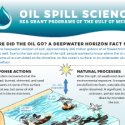
The Gulf of Mexico Research Initiative (GoMRI) is pleased to announce a new Sea Grant Fact Sheet that uses easy-to-understand graphics and descriptions about how some oil accumulated at shorelines, on the ocean’s surface, in an underwater plume, and on the seafloor.
|
|
|
Researchers modified a matrix population model to include the impact of a disturbance and study the recovery process for large marine mammal populations. They applied the model to identify key components in the recovery process for Gulf of Mexico sperm whales following a disturbance such as the Deepwater Horizon oil spill.
|
|
|
The Gulf of Mexico Research Initiative (GoMRI) is pleased to announce a new Sea Grant publication that provides helpful information about storms and oil spills. Oil and chemicals from damaged rigs and vessels can form slicks that can pollute marine and shoreline ecosystems.
|
|
|
Oil is a complex mixture of chemicals with different degradation behaviors and toxicity levels. Understanding how the compounds in spilled oil, particularly toxic compounds, change with weathering is important to predicting oil’s persistence in the environment.
|
|
|
Posted on August 17, 2017
Salt marshes support commercially and culturally important species and are often subject to natural and human-caused stressors. Gaps in our knowledge of salt marsh food webs made management and restoration decisions difficult after the Deepwater Horizon spill. Jessica Johnson helps fill this gap.
|
|
|
Posted on August 10, 2016
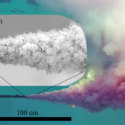
Scientists simulated an underwater blowout to analyze the formation, path, and duration of oil plumes. They noted that the simulated blowout formed two plumes, one due to momentum and plume buoyancy and another due to the buoyancy of individual oil droplets separating from the first plume.
|
|
|
Posted on August 20, 2015
Bicheng Chen is dedicated to seeking the physical explanations behind everyday phenomena. His research on ocean turbulence and numerical modeling led him to investigate the interactions among wind, waves, and turbulence and their effect on oil transport and dispersion.
|
|
|
Study Identifies Algae Species as Robust or Sensitive to Dispersed Oil
Physiological response of 10 phytoplankton species exposed to Macondo oil and the dispersant, Corexit. Bretherton, L.; Williams, A.K.; Genzer, J.; Hillhouse, J.; Kamalanathan, M.; Finkel, Z.V.; Quigg, A. Journal of Phycology, Volume54, Issue3, June 2018, Pages 317-328
Study Uses Taylor Energy Site to Understand How Riverine Fronts Influence Oil Transport
Influence of river-induced fronts on hydrocarbon transport: A multiplatform observational study. Androulidakis, Y.; Kourafalou, V.; Ozgokmen, T.; Garcia-Pineda, O.; Lund, B.; Le Hnaff, M.; Hu, C.; Haus, B.K.; Novelli, G.; Guigand, C.; Kang, H.S.; Hole, L.; Horstmann, J. Journal of Geophysical Research, Volume 123, Issue 5, May 2018, Pages 3259-3285
|
|
Dataset for: How persistent and bioavailable are oxygenated Deepwater Horizon oil transformation products? -- data link
Survey of Trauma, Resilience, and Opportunity among Neighborhoods in the Gulf (STRONG) -- data link
Dataset for: Nematode‐associated microbial taxa do not correlate with host phylogeny, geographic region or feeding morphology in marine sediment habitats -- data link
|
|
New Member of Sea Grant Oil Spill Outreach Team: Missy Partyka
The GoMRI community extends a warm welcome to Missy Partyka. Missy has a Ph.D. in integrated ecology from the University of California, Davis. She has been working closely with the public to research complex environmental issues with potential human health impacts, such as water quality and food safety.
New Collaborative Project for the Sea Grant Oil Spill Outreach Team
The team announced a new year-long collaborative project between them and the Gulf Research Program called: Regional Priority-Setting for Health, Social, and Economic Disruption from Spills. The project will feature a series of workshops to identify needs and priorities for improving oil spill preparedness.
|
|
CARMMHA Hosts First Dolphin Health Workshop with Girl Scouts
Consortia members presented the workshop at Girl Scout Headquarters in San Diego, California. They opened with information about the importance of wild Gulf of Mexico dolphins and Deepwater Horizon’s potential effects on their populations. The team then led the scouts in a mock dolphin health assessment activity using an inflatable dolphin, which included an ultrasound, body measurements, x-rays, and satellite tagging.
Get to Know CWC Scientist Logen Pietraroia
Pietraroia is a research assistant with Dr. Nancy Rabalais’s lab studying benthic infauna in subtidal areas adjacent to salt marshes in Terrebonne Bay, Louisiana. Learn more her research, background, and the importance of infauna here.
RECOVER and CARTHE Researcher Paris-Limouzy Selected for 2018 AGU Rachel Carson Lecture
This year, the American Geophysical Union chose Claire Paris-Limouzy as the outstanding female scientist to present the lecture at the annual Ocean Sciences meeting. Her cutting-edge ocean science research includes contributions such as a freely distributed numerical and empirical Lagrangian tool, the concept of Lagrangian behavioral chambers to detect how environmental cues affect planktonic organism’s navigation, and a series of trademarked Drifting In Situ Chamber (DISC) instruments. Congratulations, Claire!
|
|
|
|
|
|
|