|
|
|
|
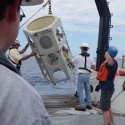
Researchers assessed several years of sediment trap collections near the Deepwater Horizon site, an active natural seep site, and a reference site to understand transport pathways and drivers of sinking particles in deepwater environments (1400 m depth).
|
|
|
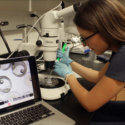
Researchers conducted exposure experiments with mahi-mahi embryos using oil, ultraviolet (UV) radiation, and temperature to determine how multiple stressors affect their survival. Compared to controls, exposed embryos floating near the ocean’s surface started to sink sooner and at faster rates, which intensified at higher temperatures.
|
|
|
The Gulf of Mexico Research Initiative (GoMRI) is pleased to announce a new Sea Grant publication that explains the role that microbes play in using oil as an energy source and removing it from the environment.
|
|
|
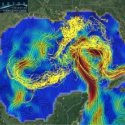
Researchers analyzed how satellite-tracked ocean surface drifters moved in the Gulf of Mexico to learn how other floating materials (oil, plastics, marine organisms) move.
|
|
|
Posted on May 23, 2017
Scientists tested a new analytical method for a fast and comprehensive characterization of organic compounds in marine sediments. The Rapid Analyte Detection and Reconnaissance (RADAR) method couples atmospheric pressure photoionization in positive ion mode (APPI-P) with Fourier transform ion cyclotron mass spectrometry (FTICR-MS).
|
|
|
Posted on May 23, 2016
When disaster strikes, responders look at how creatures in its path may be impacted to mitigate damage. Tingting Tang takes the process one step further, using mathematical models to predict how long recovery may take. The creatures that Tingting focuses on are some of the Gulf of Mexico’s largest predators and most charismatic animals, beaked and sperm whales.
|
|
|
Posted on May 26, 2015
A team of scientists from Eckerd College and University of South Florida conducted a time-series sediment study to better understand impacts from the Deepwater Horizon oil spill.
|
|
|
Study Uses Wave Tank Experiments to Learn How Dispersants Affect Oil Slick Breakup by Waves
Size distribution and dispersion of droplets generated by impingement of breaking waves on oil slicks. Li, C.; Miller, J.; Wang, J.; Koley, S.S.; Katz, J. Journal of Geophysical Research, Oceans: Volume122, Issue10, October 2017, Pages 7938-7957
Study Shows High Pressure Decreases Oil Droplet Density, Increases Droplet Diameter, and Accelerates Droplet Assent
Rise velocity of live-oil droplets in deep-sea oil spills. Pesch, S.; Jaeger, P.; Jaggi, A.; Malone, K.; Hoffmann, M.; Krause, D.; Oldenburg, T.B.P.; Schluter, M. Environmental Engineering Science, Volume 35, Issue 4, Apr 2018
|
|
Individual Measurements from trawl surveys of fish and invertebrates in Coastal Alabama, Mississippi, and the Chandeleur Islands, March - December, 2016 -- data link
Response of the planktonic and microbial community to an oil spill in Galveston Bay, Texas, March 2014 -- data link
Water column data from the northern Gulf of Mexico hypoxic zone collected in August 2016 -- data link
|
|
|
|
|
|
|