|
|
|
|
February 6, 2018 GoMRI eNews
|
|
Scientists analyzed in situ deep-depth water column measurements before and after the Deepwater Horizon well was capped and calculated degradation rate estimates for 49 hydrocarbons (23% of released spill material) and inferred the rates of an additional 5 hydrocarbons.
|
|
|
The Gulf of Mexico Research Initiative (GoMRI) is pleased to announce a new Sea Grant publication that explains which corals were affected by the Deepwater Horizon incident and how scientists are monitoring those corals. The bulletin also describes the important roles that corals play in maintaining a healthy ocean and how corals worldwide struggle in the face of constant, multiple threats.
|
|
|
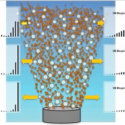
Researchers developed a new formulation to simulate gas-oil interactions within a developing underwater oil plume and applied the technique to the Deepwater Horizon incident. The simulations showed that in the absence of dispersant, gas bubbles reduced the median oil droplet and bubble sizes by up to 20%, with 30 – 50% reduction observed in intermediate gas fractions.
|
|
|
Scientists completed four field experiments in the Gulf of Mexico, linking the dynamics of deep ocean, shelf, and coastal surface currents (where materials such as oil or debris naturally accumulate) in a way that has never been done before. So how did they do that?
|
|
|
Posted on January 26, 2017
Oil droplets can attach to tiny sediment particles suspended in the water column, causing them to sink to the seafloor where they can linger for a long time. Sediment grain size influences if and how oil droplets are resuspended into the water column.
|
|
|
Posted on January 28, 2016
Scientists representing eight institutions conducted in-situ observations and laboratory experiments to determine if Hurricane Isaac redistributed sedimented oil near the Deepwater Horizon site.
|
|
|
Study Shows Landsat Imagery is Robust, Low-Cost Tool for Long-Term Marsh Monitoring
Post-Deepwater Horizon Oil Spill Monitoring of Louisiana Salt Marshes Using Landsat Imagery.
Mo, Y.; Kearney, M.S.; Riter, C. Remote Sensing, 2017, 9(6), 547
Modeling Study Finds Oil Droplets Eject Streams of Smaller Droplets in Underwater Plume
Oil jet with dispersant: Macro-scale hydrodynamics and tip streaming. Zhao, L.; Gao, F.; Boufadel, M.C.; King, T.; Robinson, B.; Lee, K.; Conmy, R. AIChE, Volume 63, Issue 11, November 2017, Pages 5222–5234
|
|
Alkane oxidation genes alkB, pmoA, and cytochrome P450 CYP153 from inland marsh soil and subtidal sediment, Grand Isle, Louisiana, 2011-2014 -- data link
Output information for "Bubble plumes in a stratified environment: Source parameters, intrusion height and neutral height" -- data link
Metagenomic insights on Microbial Community Composition within Chandeleur Island Louisiana Salt Marsh Ecosystems, July – September, 2015 -- data link
|
|
Change! Abstract Submission Deadline is Feb 23 ASLO Special Session "Oil and Water Do Mix"
Drs. Ed Buskey and Ken Lee are chairing a special session at the Association for the Sciences of Limnology and Oceanography (ASLO) 2018 Summer meeting, June 10-15, 2018, Victoria, B.C., Canada. They invite researchers to submit abstracts for their session titled: Oil and water do mix: The fate, behavior, and impact of dispersed oil droplets in the sea. Read about the session here. Read an overview of submission requirements here.
Save the Date! March 29 Sea Grant Seminar on Oil Spills and Marine Mammals
The Sea Grant Oil Spill Outreach Team will host Oil spill response, assessment, and restoration: Marine mammals at the Flower Garden Banks National Marine Sanctuary Headquarters in Galveston, Texas. The event will be free and open to the public and will also be broadcast live as a webinar. More information will be available soon at https://gulfseagrant.org/oilspilloutreach.
|
|
C-IMAGE Engages with Elementary and Middle School Students
The outreach team presented consortium research to students participating in the Mahaffey Theater Class Acts program, an arts education outreach program in St. Petersburg, Florida. The presenters explained how Gulf research is conducted after an oil spill and screened the GoMRI-focused documentary Dispatches from the Gulf.
CWC Announces 2018 Field Marine Science Camp
The camp offers high school students the opportunity to gain practical real-world experience conducting field research in coastal ecosystems. Students will engage with LUMCON research vessels, laboratories, and scientific equipment and receive mentorship from on-site scientists. The camp will take place July 15 – 21 at the DeFelice Marine Center in Cocodrie, LA. Additional details, including application information, are available here.
ECOGIG PI Named American Academy of Microbiology Fellow
Dr. Samantha Joye was recently elected to become a fellow of the American Academy of Microbiology, an honorific leadership group within the American Society of Microbiology. Fellows are chosen based on their scientific achievements and original contributions that have advanced the field of microbiology. Congratulations, Mandy!
RECOVER Revamps Website and Announces Exciting New Feature
The group recently updated their website to create an improved visitor experience, including a Virtual Reality tour of the team’s hatchery facilities. Users visiting the site on their mobile smartphone can take the free tour directly on their device using the Wonda VR software. The renovated site can be found at its new web address, http://recoverconsortium.org/.
|
|
|
|
|
|
|