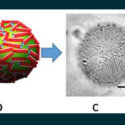
Researchers assessed various structures of clay nanotubes or halloysites, which are being studied for their potential in oil spill emulsification. They tested the nanotubes to identify which structures generated the most stable emulsions and smallest oil droplets and if catalytic reactions improved at the oil-water interface.
Posted on November 10, 2016
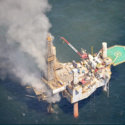
Research consortia involved in the GoMRI self-organized a rapid response to characterize the waters around the Hercules 265 rig. They found evidence of an immediate response from the surrounding environment’s microbial community to elevated methane concentrations.
Posted on November 19, 2015
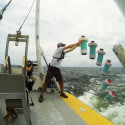
Chemical engineer Jordan Young has found his happy place on a research vessel in the Gulf of Mexico. He’s looking for changes in ocean acidity following the Deepwater Horizon spill. As the oil biologically degrades, some of it oxidizes to carbon dioxide and may increase acidification.
Posted on November 17, 2014
For Cheng Li, the beauty of our oceans is precious. He wants to protect that beauty by improving the tracking of and response to oil spills.
Posted on November 18, 2013
In the early morning hours on Monday July 23rd the Hercules 252 rig blew out, spewing a mixture of gas, condensate, and possibly other hydrocarbons into the water and air.
Hydrostatic Pressure Increases Toxicity in Daphnia magna -- data link
SWAN+ADCIRC forecast and hindcast simulations of Hurricane Isaac (2012) using GAHM -- data link
Sun glint critical angle oil detection -- data link
Video
RFP IV Update: Littoral Acoustic Demonstration-Gulf Ecological Monitoring/Modeling (Sidorovskaia)- This effort will develop an understanding of how the regional marine mammal population in the Northern Gulf of Mexico (GoM) has been affected by the 2010 Deepwater Horizon (DWH) oil spill. Changes caused by environmental stresses or human activities, can have a major impact on the function of the entire deepwater ecosystem.
ACER Hosts Boardwalk Talks
The consortium recently held community events on the Dauphin Island Sea Lab Estuarium boardwalk to introduce attendees to different focuses of their research, such as algae, microbes, and plankton. View photos from the talks here and here.
DEEPEND Masters Student Discusses Ichthyoplankton Biodiversity
Graduate student Corinne Meinert investigates biodiversity in Gulf of Mexico ichthyoplankton to determine the health of the ecosystems they live in. Greater diversity typically indicates a healthier ecosystem.
ECOGIG Video Discusses Importance of Deep-sea Coral Research
The final episode in the consortium’s three-part deep-sea coral series explains how coral studies advance our understanding of deep-sea Gulf of Mexico ecosystems and inform management and response decisions for future disturbances.