|
|
|
|
October 31, 2017 GoMRI eNews
|
|
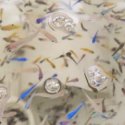
Researchers from the United States, Australia, and Europe conducted mesocosm experiments to assess how larval reef fishes respond physiologically and cognitively to low crude oil concentrations. The team observed that polycyclic aromatic hydrocarbons (PAHs), at levels recorded in industrialized sections of tropical coral reefs worldwide, increased larvae mortality and stunted growth rates.
|
|
|
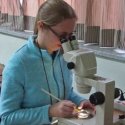
Meiofauna provide important ecosystem services such as waste removal to the deep sea-floor environment and can act as indicators of ecosystem health.
|
|
|
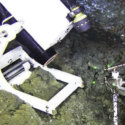
Scientists video recorded bubbles released from natural seafloor seeps in the Gulf of Mexico to determine the rate and volume of oil and gas released. The researchers observed that oily bubbles were larger and released more slowly than gaseous or mixed (part-oil, part-gas) bubbles.
|
|
|
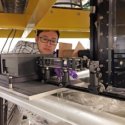
Laser light and high-speed cameras can help researchers observe the behavior of oil droplets within a laboratory-simulated oil plume and interpret how the oil subsequently may move through the water column. Xinzhi Xue uses lasers to non-invasively probe inside the oil plume and get a detailed look at the oil fragmentation process.
|
|
|
Posted on October 25, 2016
Natural and manmade disasters often involve long-term effects, but the majority of follow-up research tends to focus on the biophysical impacts rather than the social. Jacqueline Fiore, a Louisiana resident, understands how disasters such as hurricanes and oil spills can impact local industries, citizens, and ecosystems.
|
|
|
Posted on October 22, 2015
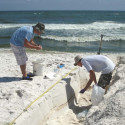
Scientists analyzed microbial communities on beaches oiled by the Deepwater Horizon spill and found taxonomic and functional changes after hydrocarbon exposure.
|
|
|
Posted on October 28, 2014
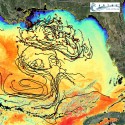
Scientists measured the speed of small, short-lived Gulf surface currents using position data from nearly 300 drifters to determine surface current impact on the dispersion of ocean contaminants.
|
|
|
Study Uses Drifter Data to Construct Gulf of Mexico Surface Dynamics
Lagrangian dynamical geography of the Gulf of Mexico. P. Miron, F. J. Beron-Vera, M. J. Olascoaga, J. Sheinbaum, P. Pérez-Brunius, and G. Froyland. Scientific Reports 7, Article number: 7021 (2017)
Study Develops Biogeographic Classification of the World’s Deep Oceans
A global biogeographic classification of the mesopelagic zone. Sutton, T.T.; Clark, M.R.; Dunn, D.C.; Halpin, P.N.; Rogers, A.D.; Guinotte, J.; Bograd, S.J.; Angel, M.V.; Perez, J.A.A.; Wishner, K.; Haedrich, R.L.; Lindsay, D.J.; Drazen, J.C.; Vereshchaka, A.; Piatkowski, U.; Morato, T.; Blachowiak-Samolyk, K.; Robison, B.H.; Gjerde, K.M.; Pierrot-Bults, A.; Bernal, P.; Reygondeau, G.; Heino, M. Deep Sea Research Part 1: Oceanographic Research Papers, Volume 126, August 2017, Pages 85-102
|
|
Chemical composition of Water Accommodated Fraction (WAF) made through three different procedures -- data link
Dataset for: Parameterization of frontal symmetric instabilities. I: Theory for Resolved Fronts -- data link
Sediment Trap (raw data) - Green Canyon, Gulf of Mexico, 1260m, April 16, 2012 - September 4, 2012 -- data link
|
|
|
RFP IV Update: Dispersion Research on Oil: Physics and Plankton Studies II - DROPPS II (Buskey) - The goal of DROPPS II is to investigate and model a series of processes affecting the fate of crude oil spills, including physical breakup and dispersion of oil patches, interactions of petroleum with marine organisms, biodegradation of oil, and the impact of aerosolized oil on public health.
|
|
|
ACER Habitat Focus Series Highlights Coastal Oceans
The coastal ocean refers to the area of the ocean whose ecosystems are affected directly or indirectly by the ecological and environmental processes on the coast and upriver Gulf of Mexico watersheds. Learn more about this unique habitat here.
C-IMAGE Researchers Attend St. Petersburg Science Festival
The team recently hosted a booth at the Festival, where they taught visiting youth about seafloor sediment layers, oil spills, and other ocean science topics. See photos of the event here.
ECOGIG Launches Coral Video Series
The consortium recently released the first episode of a three-part series highlighting different aspects of deep-sea coral. The first installment explains what a deep-sea coral is, how it eats and draws nourishment, and why these creatures are a unique element of the deep-sea ecosystem.
CARTHE Podcast Documents 1000-Drifter Release
The recent Gulfcast episode follows the crew of the LASER expedition as they drop approximately 1,000 drifters into the Gulf of Mexico. The GPS-equipped drifters will relay their locations for three months to the researchers in Miami, where the team will use the data to improve ocean current models.
|
|
|
|
|
|
|