GoMRI eNews · Oct 17, 2017 · ← All issues
Welcome to the GoMRI eNews.

Keeping you current on emerging Gulf science and the people investigating the effects of oil spills on the environment and public health.

October 17, 2017                                                                    GoMRI eNews

Stories

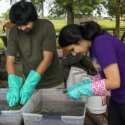
Study Assesses How Sunlight and Microbial Degradation Affect Oil-Derived Sand Patties

Video Shows New Research Tactics for Mahi-Mahi Tagging

Study Finds Different Avoidance Behaviors in Estuarine Fish to Oiled Sediment

Grad Student Bhalerao Analyzes Food Webs of Horse Fly Larvae to Assess Marsh Health

From the Archives

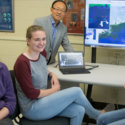
Study Introduces Computer Science Students to Problem Solving Using Deepwater Horizon Imagery

Posted on October 11, 2016
University professors developed a team-based educational project using satellite images of Deepwater Horizon surface slicks to introduce first-year computer science students to socially-relevant problem solving.

Why Grad Student Martinec Digs the Seafloor

Posted on October 15, 2015
Ceil Martinec picks microscopic creatures out of mud collected from deep in the Gulf of Mexico. She is looking for possible lingering effects of the 2010 oil spill on sediment-dwelling animals and making some exciting discoveries along the way.

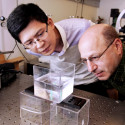
Study Shows Bursting Bubbles Can Redistribute Oil Droplets into a Water Column

Posted on October 14, 2014
Scientists using a high-speed camera to observe bubbles bursting have gained new insight into the hydrodynamics of complex fluids.

Publications

Modelling Study Shows Coastal Areas Vulnerable to Oiling In Summer and Winter 
Texas and Louisiana coastal vulnerability and shelf connectivity. Thyng, K.M.; Hetland, R.D. Marine Pollution Bulletin, Volume 116, Issues 1–2, 15 March 2017, Pages 226-233

Study Advances Research on Oiled Marine Snow
Constraining the spatial extent of marine oil snow sedimentation and flocculent accumulation following the Deepwater Horizon event using an excess 210Pb flux approach. Schwing, P.T.; Brooks, G.R.; Larson, R.A.; Holmes, C.W.; O'Malley, B.J.; Hollander, D.J. Environmental Science & Technology, 2017, 51 (11), pp 5962–5968

Data

Tabanus nigrovittatus microsatellite data for the assessment of population genetics of populations sampled from coastal Louisiana, 2015-2016 -- data link

Exposure of zebrafish embryos to 2- and 6-hydroxychrysene, chrysene and phenanthrene to assess developmental toxicity -- data link

Macrobenthic infauna of deep-sea hydrocarbon seeps in the northern Gulf of Mexico, 2012-2013 -- data link
 

Video

RFP IV Update: Deep-Pelagic Nekton Dynamics of the Gulf of Mexico - DEEPEND (Sutton)

RFP IV Update: Deep-Pelagic Nekton Dynamics of the Gulf of Mexico - DEEPEND (Sutton) - DEEPEND (Deep-Pelagic Nekton Dynamics) will investigate deep-pelagic communities on short-term (sub-generational) and long-term (evolutionary) timescales to appraise extant recovery and potential future recovery of these communities using a suite of integrated approaches.

Announcements

Project Activities

CARTHE Podcast Discusses How At-Sea Researchers Handle Inclement Weather
The latest Dispatches from the Gulf GulfCast episode examines the diverse reactions of researchers and crew to the severe storms they encountered while carrying out the LASER expedition, which took place during El Niño season.
 
CWC Blog Features REU Intern Sara Gholson
Sara is a senior marine science major at Eckerd College. She collaborated with CWC researchers to examine the diversity of macrofauna communities living in deep-sea sediment cores for her Research Experience for Undergraduates (REU) project. Learn more about Sara’s background and research.
 
ECOGIG Researcher Awarded Women in Science STEM Grant
The L’Oreal USA For Women in Science program recently awarded Dr. Laura Lapham a “Changing the Face of STEM” mentoring grant, which targets programs focused on engaging girls and women in science, technology, engineering, and math. Congratulations, Laura!
 
RECOVER Scientists Secure Research Fish Prior to Hurricane Irma
University of Miami researchers transported important research fish from the outdoor hatchery into the shelter of the university’s SUSTAIN facility – the world’s largest hurricane simulator – ahead of Hurricane Irma’s arrival. The effort saved many valuable fish, and the team is working to return to previous research schedules.
 
Meet C-IMAGE Student of the Month Nathali Schmid
Nathali is a master’s student at Hamburg University of Technology. She conducts high-pressure experiments that will help derive a model to describe droplet size distribution based on physical and hydrodynamic properties rather than surroundings. Learn more about her background and research.