|
|
|
|
September 19, 2017 GoMRI eNews
|
|
Scientists used data collected during the Deepwater Horizon spill to validate a model simulation of the physical and chemical behavior of oil and gas rising from the wellhead to the ocean surface.
|
|
|
Researchers use numerical models to simulate oil spill scenarios and predict where oil will go, but the many factors that affect the oil’s path creates uncertainty in the predictions. Shitao Wang quantifies the uncertainty of ocean models to gauge the reliability of oil fate predictions.
|
|
|
Principal Investigator Antonietta Quigg describes ongoing research about marine oil snow formation during the Deepwater Horizon spill and its effects on Gulf of Mexico environments. She discusses how this research could inform oil spill response and shares some preliminary results that surprised their research group.
|
|
|
Scientists analyzed model simulations of tracer dispersion in a Gulf of Mexico eddy to find out if small-scale flows surrounding the eddy influenced where the tracer went.
|
|
|
Posted on September 13, 2016
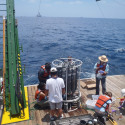
There are hundreds of deep-pelagic fish species in the Gulf of Mexico, but we know very little about their taxonomy, diversity, and population sizes. Max Weber plans to catch fifteen individual specimens of each of the 500 known deep-sea Gulf fish species to help us better understand these organisms and how the Deepwater Horizon oil spill may have impacted them and environment.
|
|
|
Posted on September 10, 2015
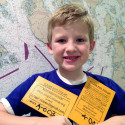
Fueled by a passion for science and endangered species, Alek designed and executed a research project that involved scientists from eight institutions, four-hundred drift cards, and over a year’s work. A substantial undertaking for any scientist, this is even more impressive because Alek is seven years old.
|
|
|
Posted on September 16, 2014
From March-December 2010 during ten research cruises covering over 105,000 square kilometers, scientists documented the fate and dynamics of Deepwater Horizon methane emissions around the blowout site.
|
|
|
Clay Nanotubes for Oil Emulsification Are More Efficient than Spherical Microparticles
Halloysites stabilized emulsions for hydroformylation of long chain olefins. von Klitzing, R.; Stehl, D.; Pogrzeba, T.; Schomacker, R.; Minullina, R.; Panchal, A.; Konnova, S.; Fakhrullin, R.; Koetz, J.; Mohwald, H.; Lvov, Y. Advanced Materials Interfaces, 2017, Volume 4, 600435
Study Evaluates how Red Drum, Florida Pompano, and Southern Flounder Metobilizes PAHs
Species-specific metabolism of naphthalene and phenanthrene in three species of marine teleosts exposed to Deepwater Horizon crude oil. Pulster, E.L.; Main, K.; Wetzel, D.; Murawski, S., Environmental Toxicology and Chemistry, 2017 Jun 21. doi: 10.1002/etc.3898
|
|
Monitoring and Assessment of Coastal and Marine Ecosystems in the Northern Gulf: historical database of trace metal, nutrients, chlorophyll-a and hydrographic data in the Mississippi Bight and Sound from October 2007 to November 2011 -- data link
Cloud free Sea Surface Temperature and Chlorophyll-a analysis (2003-2012) -- data link
Landsat based Sargassum coverage in the Northern Gulf of Mexico, 2010 -- data link
|
|
|
RFP IV Update: Oil Spill Exposure Pathways in Coastal River-Dominated Ecosystems (Graham) - The Consortium for Oil Spill Exposure Pathways in Coastal River-Dominated Ecosystems (CONCORDE) expressly addresses how complex fine-scale structure and processes in coastal waters dominated by pulsed-river plumes control the exposure, impacts, and ecosystem recovery from offshore spills like the Deepwater Horizon release of 2010.
|
|
|
|
|
|
|
|