GoMRI eNews · Sep 5, 2017 · ← All issues
Welcome to the GoMRI eNews.

Keeping you current on emerging Gulf science and the people investigating the effects of oil spills on the environment and public health.

September 5, 2017                                                                    GoMRI eNews

Stories

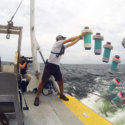
Aeppli and Murphy Awarded National Academies’ Gulf Research Program Fellowships

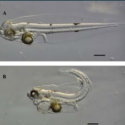
Study Finds Oil Exposure Reduces Cardiac Function and Survival in Red Drum Larvae

Grad Student Malone Uses Engineering Skills to Put Pressure on Oil

Samantha Joye and Wei-Jun Cai Elected 2017 AGU Fellows

From the Archives

Rapid Response Study Characterizes Behaviors of Accidental Short-Term Oil Blowouts

Posted on August 26, 2016
An interdisciplinary scientific team conducted a rapid response sampling campaign in the immediate aftermath of the 2013 Hercules 265 blowout to determine if sediment and fish were polluted above established baseline levels.

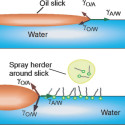
Study: Eco-Friendly Oil Herders Show Promise for Effective Marine Spill Cleanup

Posted on August 26, 2015
Scientists demonstrated an effective and environmentally benign technology to harness the forces that cause an oil spill to spread.

Study Shows Dispersant Lingered in Gulf Four Years after Oil Spill

Posted on August 27, 2014
Scientists from Haverford College and Woods Hole Oceanographic Institution investigated the presence of dispersants following the Deepwater Horizon oil spill.

Publications

Study Demonstrates Importance of Atmospheric Forcing for Coastal Transport Predictions  
Oceanic ensemble forecasting in the Gulf of Mexico: An application to the case of the Deepwater Horizon oil spill. Khade, V.; Kurian, J.; Chang, P.; Szunyogh, I.; Thyng, K.; Montuoro, R., Ocean Modelling, Volume 113, May 2017, Pages 171-184

Study Measures Influence of Pressure and Temperature on Oil Fate
Experimental simulation of crude oil-water partitioning behavior of BTEX compounds during a deep submarine oil spill. Jaggi, A.; Snowdon, R.W.; Stopford, A.; Radovic, J.R.; Oldenburg, T.B.P.; Larter, S.R., Organic Geochemistry, Volume 108, June 2017, Pages 1-8

Data

Motion of microswimmers near a weakly deforming interface -- data link

Nitrogen cycling processes in oil impacted salt marshes on Chandeleur Islands, July, 2015 through February, 2016 -- data link

CTD profile data of the Mississippi Bight, Mobile Bay and Western Florida Shelf off the R/V Point Sur during July 2016 -- data link

Video

RFP IV Update: Consortium for Adv. Res. on Transport of Hydrocarbon in the Environment (Özgökmen)

RFP IV Update: Consortium for Adv. Res. on Transport of Hydrocarbon in the Environment (Özgökmen) - CARTHE focuses on advancing fundamental understanding and modeling of the diverse physical mechanisms responsible for hydrocarbon transport in the Gulf of Mexico environment.

Announcements

Submit Abstracts by September 11 for 2018 Gulf of Mexico Oil Spill & Ecosystem Science Conference
Applicants will be notified of abstract acceptance/rejection by late-October. You do not need to register for the conference to submit an abstract. Each person may submit up to two (2) abstracts as lead author. Abstracts should promote fundamental Gulf ecosystem science or link scientific results to ecosystem resilience, oil spill response, or restoration and management.

Project Activities

CARTHE Prepares for Year Two of Bay Drift Project
The Bay Drift Project is a citizen-science experiment that uses drift cards to help determine the origins of the trash that washes up on the Vizcaya Museum and Garden’s shoreline. Consortium representatives and Vizcaya hosted an event to highlight results from the project’s first year and to prepare drift cards and identify goals for the project’s second year.
 
Get to Know CRGC Grad Student Patel
Megha Patel is a social work Ph.D. student at Tulane University and a member of the consortium’s Community Action Planning and Resilience Building efforts. Learn more about her background and research interests here.
 
CWC Young Scientist Newsletter Features Tropical Cyclones
The issue contains fun facts, keywords, and graphs about the formation and history of tropical cyclones as well as hurricane-themed puzzles and resources. The issue is now available for download.
 
RECOVER Enlists Professional Anglers for Mahi Tagging Experiment
The experiment uses satellite tags attached to adult mahi to help determine if consortium experiments could be replicated in the wild. Experienced anglers can help increase the amount of fish researchers catch in a day and reduce stressful fight times on the line to ensure that the tagged fish are as healthy as possible.