|
|
|
|
August 22, 2017 GoMRI eNews
|
|
Salt marshes support commercially and culturally important species and are often subject to natural and human-caused stressors. Gaps in our knowledge of salt marsh food webs made management and restoration decisions difficult after the Deepwater Horizon spill. Jessica Johnson helps fill this gap.
|
|
|
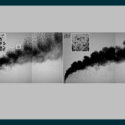
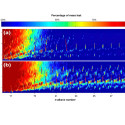
Scientists conducted laboratory experiments with a simulated oil plume to assess how chemical dispersants affect a crude oil jet as it transitions into a plume under crossflow conditions.
|
|
|
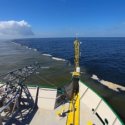
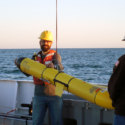
Response decisions during Deepwater Horizon relied on forecasts of where the oil was going and when it would get there. Researchers with the CARTHE consortium have been working to improve the information that goes into making ocean transport forecasts.
|
|
|
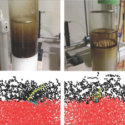
Researchers combined laboratory experiments and molecular simulations to examine how two Corexit surfactants – DOSS (dioctyl sulfosuccinate) and Span 80 – individually affect oil aerosolization.
|
|
|
Posted on August 17, 2016
Microscopic organisms called plankton, an important component of the marine food web, congregate in the freshwater-laden coastal waters of the northern Gulf of Mexico. Adam Boyette wants to learn more about how and where these plankton live to better understand how an oil spill or other disaster might impact their populations.
|
|
|
Posted on August 20, 2015
Bicheng Chen is dedicated to seeking the physical explanations behind everyday phenomena. His research on ocean turbulence and numerical modeling led him to investigate the interactions among wind, waves, and turbulence and their effect on oil transport and dispersion.
|
|
|
Posted on August 19, 2014
U.S. and Swiss chemists used comprehensive two-dimensional gas chromatography (GCxGC) to more accurately understand oil fate from the Deepwater Horizon spill.
|
|
|
Study Establishes Baseline Information on Capacity of Estuarine Fish to Avoid Oil
Avoidance of oil contaminated sediments by estuarine fishes. Martin, C., Marine Ecology Progress Series, Vol. 576: 125–134, 2017, https://doi.org/10.3354/meps12084
Study Gives Insights into Relationship of Disaster Magnitude, Duration, and Whale Recovery
Analysis of lethal and sublethal impacts of environmental disasters on sperm whales using stochastic modeling. Ackleh, A.S.; Chiquet, R.A.; Ma, B.; Tang, T.; Caswell, H.; Veprauskas, A.; Sidorovskaia, N., Ecotoxicology, August 2017, Volume 26, Issue 6, pp 820–830
|
|
Motion of microswimmers near a weakly deforming interface -- data link
Nitrogen cycling processes in oil impacted salt marshes on Chandeleur Islands, July, 2015 through February, 2016 -- data link
CTD profile data of the Mississippi Bight, Mobile Bay and Western Florida Shelf off the R/V Point Sur during July 2016 -- data link
|
|
|
RFP IV Update: Coastal Waters Consortium II (Rabalais) - There is an ecosystem-wide legacy of the Deepwater Horizon (DWH) oil spill that extends beyond three years.
|
|
|
Updates: 2018 Gulf of Mexico Oil Spill & Ecosystem Science Conference
- Registration Fee Waived for Students Giving Presentations The Gulf Research Program, the Gulf of Mexico University Research Collaborative, and the Harte Research Institute are providing registration waivers for students who are giving oral or poster presentations. Students should submit abstracts and identify that they are a student. Registration waivers will be included with presentation acceptance notifications in late October.
- Call for Workshops The conference will provide a meeting room and AV equipment and help promote workshops. If you wish to organize a conference workshop, see details and submit required information to the conference organizers (gulfconference@oceanleadership.org). Workshop proposals will be accepted on a "first come, first served" basis.
GoMRI Research to be Presented at American Fisheries Society Symposia
Scientists representing several GoMRI-funded consortia will be presenting at several symposia at the 147th annual AFS meeting. Check out the topics and schedules here.
|
|
ACER Tool Talk Series Features Stable Isotope Analysis
Consortium researchers use this technique to determine stable isotope ratios in an organism’s tissues to reconstruct food webs in oiled and non-oiled coastal environments.
CARTHE and Waterlust Release “The Motion of the Ocean” Video
CARTHE has conducted some of the largest ocean current surveys and expeditions to collect important data about material transport in the ocean. This video highlights the tools and techniques that modern researchers use to study ocean currents and develop more accurate ocean circulation models.
C-IMAGE Highlights Applications of New In-Situ Pump
The pump filters large volumes of water through three filters (a pre-filter to catch large particles or detritus, a particulates filter, and a microbe filter) to ensure that samples represent enough volume to measure certain parameters in the water.
CONCORDE Identifies New Details about Gulf Plankton and Marine Snow Distribution Patterns
Early analyses of images collected during consortium research cruises are finding new ways that the physical environment affects the distribution of organisms and marine snow in the water column. Read more about their analyses here.
Get to Know CWC Researcher Giulio Mariotti
Mariotti is a geobiologist developing a model to predict the rate at which marshes retreat due to waves and pond formation. His research will help predict future marsh loss and identify strategies to reduce it. Learn more about his background and research here!
DEEPEND Hosts American Heritage School Science Camp Students
Twenty students recently visited consortium researchers at Nova Southeastern University to learn about deep-sea organisms. The students heard presentations from graduate students, observed an active toxicity experiment, and helped researchers collect data during an hourly monitoring of oil-exposed crustaceans.
GoMRI Researchers Receive Gulf Research Program Fellowships
The National Academies of Sciences, Engineering, and Medicine recently selected David Murphy and Christoph Aeppli as Early-Career Research and Science Policy fellows. The fellowships recognize pre-tenure scientists for their exceptional leadership, performance, and potential future contributions to improving oil system safety, human health, or environmental protection. Congratulations, David and Christoph!
|
|
|
|
|
|
|