|
|
|
|
July 25, 2017 GoMRI eNews
|
|
Gulf-wide baseline for oil pollution monitoring complete! Marine scientists advanced academic relations between the U.S. and Cuba during an 18-day research expedition (May 8-25) off the northwest coast of the island nation.
|
|
|
Researchers conducted laboratory experiments on mahi-mahi embryos to determine the effects of ultraviolet radiation (UV) and oil co-exposure during different times in their development. The team observed that UV affected the success of mahi-mahi hatch in all exposure scenarios compared to controls but was highest (a 1.6- to 6-fold increase) when co-exposure occurred late in embryonic development.
|
|
|
Vanessa Parks compiles and analyzes data on Gulf Coast communities that explores how the Deepwater Horizon oil spill affected mental and physical health and how social factors contributed to post-disaster health outcomes.
|
|
|
Scientists developed and validated a high-resolution mass spectrometry method to fill data gaps in existing methods that detect the surfactant DOSS, a significant Corexit component, in sediments near the Deepwater Horizon spill site.
|
|
|
Posted on July 20, 2016
Scientists conducted a meta-analysis of Gulf of Mexico fiddler crab data across multiple years, sites, and studies to examine if the Deepwater Horizon oil spill impacted the crabs’ size, abundance, and population composition.
|
|
|
Posted on July 15, 2015
Oil Spill Research Makes Great Strides with Gulf of Mexico Research Initiative Funding
|
|
|
Posted on July 23, 2014
Alexandra Harper, a passionate environmental advocate, is using her oceanography expertise to help “society better balance human need with ecological health.”
|
|
|
Modeling Study Identifies Collision Mechanisms and Trends for Oil Drops and Marine Particle Aggregates
Collision of oil droplets with marine aggregates: Effect of droplet size, Lambert, R.A.; Variano, E.A., Journal of Geophysical Research Oceans, Volume 121, Issue 5, May 2016, Pages 3250–3260
Proceedings Describe How ASVs Improve Marine Mammal Monitoring
Using autonomous surface vehicles for passive acoustic monitoring (PAM). Ziegwied, A.; Dobbin, V.; Pierpoint, C.; Sidorovskaia, N.; Dyer, S. OCEANS 2016 MTS/IEEE Monterey, CA, 2016, pp. 1-5. doi: 10.1109/OCEANS.2016.7761380
|
|
Gulf of Mexico NCOM forecasts during the LASER experiment (January-April 2016) -- data link
Seaside Sparrow nest success on oiled and unoiled plots in Barataria Bay, LA, 2016 -- data link
Site characterization using estimates of vegetative cover at Chandeleur Island, 2015 -- data link
|
|
|
RFP IV Update: Alabama Center for Ecological Resilience (Valentine) - The ACER objectives are: To assess how coastal ecosystem structure, as measured by multiple estimates of biodiversity, and functioning (its provision of valuable processes and services) have been affected by differential exposure to Deepwater Horizon oiling.
|
|
|
Call for Workshops 2018 Gulf of Mexico Oil Spill & Ecosystem Science Conference
The conference will provide a meeting room and AV equipment and help promote workshops. If you wish to organize a conference workshop, see details here and submit required information to the conference organizers ( gulfconference@oceanleadership.org). Workshop proposals will be accepted on a "first come, first served" basis.
GRIIDC Attends Workshop on Managing Deepwater Horizon Data for the Future
NOAA's Office of Response and Restoration, in partnership with NOAA's National Marine Fisheries Service Restoration Center and NOAA's National Centers for Environmental Information hosted the Deepwater Horizon Long Term Data Management Coordination Workshop, June 7-8 in Mobile, Alabama. Read a recap of the workshop here.
|
|
CARTHE Drifter Study Tracks Oil Near Mississippi Delta Platform Leak
They coordinated with another GoMRI project led by Villy Kourafalou to conduct a unique study that observed oil’s movement using satellites, drones, and surface current drifters to improve how responders monitor and predict oil transport. Researchers focused on an oil platform just offshore the Mississippi Delta and collected unprecedented information about the way Gulf of Mexico fronts created by spreading river waters influence hydrocarbons pathways.
ECOGIG Hosts Second Annual Ocean Discovery Camp
Campers aged 11-14 explored ocean topics such as deep oceans, ecosystems, and chemosynthetic processes through hands-on projects, games, videos, and slideshows. The students also designed and built their own remotely operated vehicles (ROVs) and created stop-motion videos based on the camp’s themes. View the campers’ ROVs, watch their stop-motion films, and see photos from the camp.
LADC-GEMM Releases Drone Footage of Cruise
The consortium’s recent visual and acoustic survey of the northern Gulf of Mexico assessed changes in marine mammal distribution and ambient noise levels following the Deepwater Horizon oil spill. This short clip follows the R/V Pelican as it surveys the area.
RECOVER Achieves Mahi Catch and Release Milestone
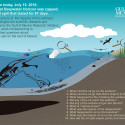
The group recently completed the first-ever capture, tag, and release of a mahi after 24 hours onboard a vessel. Researchers released the healthy female into the Gulfstream, where her tag will collect light, temperature, and acceleration data for 96 days before releasing the fish and floating back to the surface.
|
|
|
|
|
|
|