|
|
|
|
April 4, 2017 GoMRI eNews
|
|
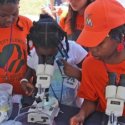
A child’s face lit up with wonder as she peered into a microscope for the first time and discovered a new world. Researchers at the Miami-based RECOVER consortium want experiences like this to happen more often for more students, so they designed and developed the RECOVER Virtual Lab.
|
|
|
Deep-sea corals are important organisms that support a healthy and diverse deep-sea ecosystem. However, there is much we do not know about certain coral species, including how they grow, reproduce, or interact with other organisms.
|
|
|
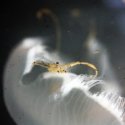
Scientists conducted laboratory experiments to examine the influence of moon jellyfish (Aurelia aurita) on crude oil aggregation and degradation. The researchers found that jellyfish swimming in a dispersed oil solution produced copious amounts of mucus which formed aggregates containing 26 times more oil than the surrounding water.
|
|
|
Posted on March 31, 2016
Laura Timm examines connections among shellfish ecology and evolution to help scientists understand how the Deepwater Horizon oil spill affected certain Gulf of Mexico species: “My work focuses on establishing pre-spill baselines and comparing them to samples taken 3-7 years after the oil spill, providing a timeline of crustacean recovery.”
|
|
|
Posted on March 24, 2015
University of California Marine Science Institute researcher Uta Passow investigated the formation of aggregated oil and organic material, commonly called marine snow, after the Deepwater Horizon spill.
|
|
|
Posted on April 1, 2014
A team of researchers from Texas, Florida, and California successfully quantified the gene expression of wild Fundulus grandis, commonly known as Gulf killifish, from the northern Gulf of Mexico in assessing exposure to toxicants from the 2010 oil spill.
|
|
|
Study Reveals a Food Web Link Between Oil Exposure and a Terrestrial Ecosystem
Incorporation of Deepwater Horizon oil in a terrestrial bird. Bonisoli-Alquati, A.; Stouffer, P.C.; Turner, R.E.; Woltmann, S.; Taylor, S.S. Environmental Research Letters, 11 (2016) 114023
Study Links Microbial Community Signatures and Hydrocarbon Content in Sediment
Distinct bacterial communities in surficial seafloor sediments following the 2010 Deepwater Horizon blowout. Yang, T.; Speare, K.; McKay, L.; MacGregor, B.J.; Joye, S.B.; Teske, A. Frontiers in Microbiology, Volume 7, 2016, 1384
|
|
Laboratory experiments on three species of fish to determine avoidance of Macondo oil -- data link
Oil extraction Visible Infrared Imaging Radiometer Suite (VIIRS) Imagery, Western Gulf of Mexico 2005-2013 - data link
Organic data (alkane, PAHs, olefin, biomarkers, and black carbon) in sediment traps deployed in 2010 to 2011 - data link
|
|
|
Where Did the Oil Go? (Dispatches from the Gulf)
To the causal observer, it’s hard to believe that the Gulf of Mexico is still under stress six years after the Deepwater Horizon oil spill...
So what happened to more than 200 million gallons of leaked oil? And was the use of dispersants a good choice or a bad choice?
|
|
|
ACER Highlights Coastal Habitats
The consortium focused a recent "Habitat Focus" blog post on how the Gulf of Mexico's coastal geography creates important and dynamic habitats such as estuaries, back bays, and lagoons.
CARTHE Hosts Poetry Competition Winners
Students participating in the Piano Slam contest created works of poetry inspired by a specific musical selection. The winners of this year’s contest and their families were invited to visit the University of Miami, where they toured the Rosenstiel School of Marine and Atmospheric Science, learned about CARTHE research, and rewatched their winning poetry performances.
Meet C-IMAGE Student of the Month Bekka Larson
Larson, a Ph.D. student at the University of South Florida, has been studying Gulf sediment since 2010. She analyzes how the seafloor environment changes after an oil spill using high-resolution core sampling. Learn more about her research and background here!
CRGC Hosts Second Executive Leadership Training Module
The Southern Louisiana Disaster Resilience Leadership Fellows, fifteen emerging local leaders representing Louisiana’s five coastal parishes, are an important aspect of CRGC’s community action planning and resilience building component. They are being trained to provide diverse disaster resilience leadership and coordination.
Get to Know CWC Researcher Ariella Chelsky
Chelsky is a postdoctoral researcher at the Louisiana Universities Marine Consortium (LUMCON). She is studying Deepwater Horizon’s biogeochemical effects on Louisiana’s coastal salt marshes, particularly nitrogen cycling and greenhouse gas production. Learn more about her and her research here!
|
|
|
|
|
|
|