|
|
|
|
March 21, 2017 GoMRI eNews
|
|
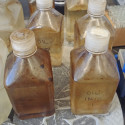
Scientists observed in laboratory experiments the formation of extracellular polymeric substances (EPS, a natural microorganism excretion) when phytoplankton and their associated bacteria were exposed to Corexit dispersant.
|
|
|
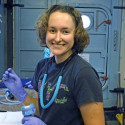
When Deepwater Horizon oil approached coastal environments, it was unclear how river water entering the Gulf of Mexico would affect the oil’s transport and fate. Steve Dykstra uses drifters and ship-deployed sensors to study how freshwater plumes disperse in the coastal environment over different seafloor topography.
|
|
|
Interactions among wind, waves, and upper-ocean currents are essential factors in predicting oil slick transport and fate. These complex interactions, however, make capturing their dynamics in simulations challenging, especially when turbulent weather conditions are present.
|
|
|
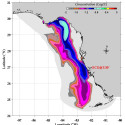
Scientists assessed the behavior of a Florida river plume to determine how it might influence the transport and dispersion of surface oil near coastal regions. The researchers found that the near-surface measurements of dissipation at the front’s bounding edge were four orders of magnitude larger than the environment beneath.
|
|
|
Posted on March 17, 2016
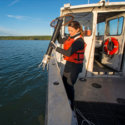
Kelsey Rogers looks for evidence of oil and methane intrusion into Gulf of Mexico water and sediment, but finding these hydrocarbons is only the beginning of her work. Like a scientific crime scene investigator, Kelsey analyzes the chemical fingerprints of oil and gas and uses them to identify their source, such as from an oil spill or a natural seafloor seep.
|
|
|
Posted on March 10, 2015
ADDOMEx studies microbial biofilms’ impacts on oil and dispersants
|
|
|
Posted on March 17, 2014
Scientists from the University of South Florida used circulation models to conduct a tracer simulation and compared output patterns with ecological analyses to determine the possibility that hydrocarbons from the Deepwater Horizon oil spill could have moved onto the West Florida Shelf
|
|
|
Study Analyzes Metabolic Pathways of Oil-Degrading Bacteria
Reconstructing metabolic pathways of hydrocarbon-degrading bacteria from the Deepwater Horizon oil spill. Dombrowski, N.; Donaho, J.A.; Gutierrez, T.; Seitz, K.W.; Teske, A.P.; Baker, B.J. Nature Microbiology Letters, 9 May 2016, Article Number 16057, DOI: 10.1038/NMICROBIOL.2016.57
Laboratory Study Shows Reduced Cardiac Function in Oil-Exposed Red Drum Larvae
Cardiac function and survival are affected by crude oil in larval red drum, Sciaenops ocellatus. Khursigara. A.J.; Perrichon, P.; Martinez Bautista, N.; Burggren, W.W.; Esbaugh, A.J. Science of the Total Environment, Volume 579, 1 February 2017, Pages 797–804
|
|
Autonomous surface vehicle-towed passive acoustic data from the Northern Gulf of Mexico June 24-30, 2015 -- data link
Ixtoc-I oil spill footprints derived from Coastal Zone Color Scanner and Landsat/MSS imagery -- data link
Numerical Simulations of Rotating, Buoyant Plumes in Stratified Environments for Four Rossby Numbers -- data link
|
|
|
Dispatches From The Gulf - 2
A sequel to the Emmy Award-winning documentary, “Dispatches From The Gulf - 2” shares remarkable stories about the global team of scientists who continue to study the 2010 Deepwater Horizon oil spill — the largest in U.S. history.
|
|
|
CARTHE Researcher Named UCAR Trustee
Dr. Shuyi Chen is an expert in extreme weather prediction and an ocean science professor at the University of Miami’s Rosenstiel School of Marine and Atmospheric Science. Dr. Chen was recently selected as a board member for the University Corporation for Atmospheric Research (UCAR), a nonprofit consortium that targets atmospheric and related Earth system sciences research and training. Congratulations!
C-IMAGE’s The Loop Podcast Highlights Deepwater Horizon’s Risks to Fish
The podcast’s most recent episode features Mote Marine Laboratory’s Dana Wetzel and Kevan Main, who analyze how fish’s bodies recover after exposure to small oil doses in their food, water, or seafloor sediments. Wetzel, Main, and Matt Resley discuss how understanding the risks fish have during oil spills can assist oil spill response decisions.
Meet CRGC Graduate Student Nicholas Thomas
Nicholas is a Ph.D. student at the Tulane School of Public Health and Tropical Medicine with an interest in disaster- and conflict-related displacement. Learn more about his background and research interests here!
CWC Postpones Gulf Lagniappe Workshop on Seaside Sparrows
The year's first Gulf Lagniappe adult education workshop has been postponed until Saturday, April 8. The workshop includes a pontoon boat trip, bird watching, a DeFelice Marine Center tour, and a lesson from Louisiana State University’s Dr. Phil Stouffer about seaside sparrows’ role as a Louisiana marsh indicator species. Contact Emily Rosser at 985-851-2844 or erosser@lumcon.edu to get more information and reserve your spot.
DEEPEND Announces 2017 Creep into the Deep Summer Caps
The 2017 DEEPEND Summer Camps are geared toward K-6 students and will be offered in eight different states. Campers will engage in science-oriented crafts and activities based on DEEPEND research. Find a camp near you!
ECOGIG to Screen Ripple Effect Film Project Finalists
Georgia filmmakers created short films for the Ripple Effect film contest exploring how human behavior impacts the world’s oceans. A premiere event will take place at the Morton Theater in Athens, Georgia, on March 25, 2017. Join ECOGIG and their partners on the “blue carpet” to meet the award winners and vote for audience choice awards!
|
|
|
|
|
|
|