|
|
|
|
December 27, 2016 GoMRI eNews
|
|
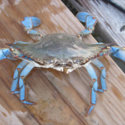
Louisiana scientists conducted genetic sequencing on oil-exposed blue crabs to identify genes involved in the blue crabs’ short-term responses to oil.
|
|
|
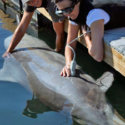
Concern about how the Deepwater Horizon oil spill may continue to negatively affect wild bottlenose dolphins living in the spill’s footprint remains high.
|
|
|
When oil from the Deepwater Horizon spill began approaching land, one proposed response was to divert Mississippi River water and sediment into the marshes to try and push surface oil more towards the Louisiana-Texas shelf. Linlin Cui is investigating the impacts of Mississippi River diversions on Barataria Bay hydrodynamics to help inform how future oil spill responders plan and execute freshwater diversions.
|
|
|
Scientists analyzed synthetic aperture radar satellite (SAR) imagery to compare the magnitude and distribution of floating oil from natural seeps in the Gulf of Mexico and the Deepwater Horizon spill.
|
|
|
Posted on December 22, 2015
An international science team examined the effects of dispersant on the activity and composition of oil-degrading marine microorganisms.The researchers found that the biodegraded oil-derived compounds exhibited a specific molecular composition that distinguished them from naturally occurring dissolved organic matter.
|
|
|
Posted on December 16, 2014
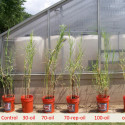
Louisiana State University scientists simulated Deepwater Horizon oiling scenarios with a dominant Mississippi River Delta marsh reed and analyzed its reaction to oil exposure.
|
|
|
Posted on December 16, 2013
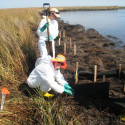
Scientists from the University of Florida surveyed the vegetation at oiled and non-oiled Louisiana marsh sites to assess impacts from the Deepwater Horizon oil spill.
|
|
|
Study Tests Marine Snow Formation in Presence of Chemical Dispersants and Phytoplankton
Oil spill dispersants induce formation of marine snow by phytoplankton-associated bacteria. van Eenennaam, J.S.; Wei, Y.; Grolle, K.C.F.; Foekema, E.M.; Murk, A.T.J. Marine Pollution Bulletin. Volume 104, Issues 1–2, 15 March 2016, Pages 294–302
Study Characterizes Deepwater Horizon Oil Slick Using AVIRIS Data
Oil slick morphology derived from AVIRIS measurements of the Deepwater Horizon oil spill: Implications for spatial resolution requirements of remote sensors. Sun, S.; Hu, C.; Feng, L.; Swayze, G.A.; Holmes, J.; Graettinger, G.; MacDonald, I.; Garcia, O.; Leifer, I. Marine Pollution Bulletin. Volume 103, Issues 1–2, 15 February 2016, Pages 276–285
|
|
Coastal water with coastal microbial concentrate (COAST): Microbial cell and micro-aggregate counts with parallel beta-galactosidase activity measurements - data link
Diet of Dolphinfish (Coryphaena hippurus) caught in the Western Gulf of Mexico, 2010-2011 - data link
Dataset For: Combined effects of Deepwater Horizon crude oil exposure, temperature and developmental stage on oxygen consumption of embryonic and larval mahi-mahi - data link
|
|
|
GoMRI RFP-V: Impact of Deepwater Horizon oil spill on behaviors of fishers in Gulf of Mexico (Saul)
Project is lead by P.I. Steven Saul, Arizona State University.
|
|
|
ACER Blog Explains Mass Spectrometry
A mass spectrometer is an important scientific instrument that researchers use to determine the masses of specific chemical elements in a sample. It has applications to many different fields, including genetics, biochemistry, pharmaceuticals, environmental science, geology, and ecology.
C-IMAGE Releases Aerial Video of OneGulf Expedition
The short clip depicts scientists and crew working aboard the R/V Weatherbird II to learn more about the long-term fate of two of the world’s largest subsea oil spills, the 1979 Ixtoc-I and the 2010 Deepwater Horizon.
CONCORDE Representatives Attend Women in Science Event
Several consortium staff members attended a women in science lunch event at the University of Southern Mississippi Gulf Coast Research Laboratory, where Dr. Marie des Neiges Leonard facilitated a discussion about the importance of mentoring early career scientists.
DROPPS Researchers Participate in Film and Discussion Series
The UTMSI event featured the films Can the Gulf Survive? and Dispatches from the Gulf, and consortium scientists answered questions from the audience after the screenings.
RECOVER Student Wins University of North Texas Graduate Student Innovator Award
Biology Ph.D. student Derek Nelson performs open-heart surgery on mahi-mahi and implants sensors on their hearts to monitor cardiac functions including heart rate and stroke volume and contractility. Congratulations, Derek!
|
|
|
|
|
|
|