|
|
|
|
November 1, 2016 GoMRI eNews
|
|
Scientists conducted exposure experiments on Gulf killifish populations with known adaptions to common environmental contaminates to determine how rapid adaptation affects future fish health.
|
|
|
Natural and manmade disasters often involve long-term effects, but the majority of follow-up research tends to focus on the biophysical impacts rather than the social. Jacqueline Fiore, a Louisiana resident, understands how disasters such as hurricanes and oil spills can impact local industries, citizens, and ecosystems.
|
|
|
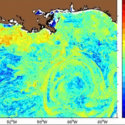
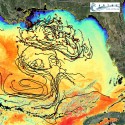
Scientists analyzed Gulf of Mexico model simulations to understand the flow processes that drive clustering of buoyant material such as Sargassum, oil from seeps and spills, and debris on the ocean surface.
|
|
|
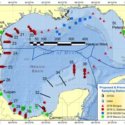
An international science team recently completed a 4,000-mile expedition to learn more about the long-term fate of two of the world’s largest subsea oil spills, the 1979 Ixtoc-I and the 2010 Deepwater Horizon. The 40-day Gulf of Mexico voyage continued their 2015 field campaign, contributing to a multi-year Gulf-wide analysis of these oil spills and the marine environment’s response and recovery.
|
|
|
Posted on October 28, 2015
Jarrett Cruz has been all over the world studying nannoplankton, a marine species he did not know existed when his journey began. Jarrett’s research into these minuscule creatures spans both biology and geology as he studies the impact of oil on nannoplankton that live in the Gulf of Mexico.
|
|
|
Posted on October 28, 2014
Scientists measured the speed of small, short-lived Gulf surface currents using position data from nearly 300 drifters to determine surface current impact on the dispersion of ocean contaminants.
|
|
|
Posted on October 30, 2013
Many people outside of the Gulf Coast region are not aware of the large population of Vietnamese residents who live across this area, in concentrated communities from Texas to Alabama.
|
|
|
Study Demonstrates Differences in Surface Dynamics for Crude and Weathered Oil
Surface dynamics of crude and weathered oil in the presence of dispersants: Laboratory experiment and numerical simulation. Soloviev, A.V.; Haus, B.K.; McGauley, M.G.; Dean, C.W.; Ortiz-Suslow, D.G.; Laxague, N.J.M.; Ozgokmen, T.M. Journal of Geophysical Research, Oceans, Volume 121, Issue 5, May 2016, Pages 3502–3516.
|
|
Raw and processed negative electrospray ionization coupled to Fourier transform ion cyclotron resonance mass spectrometry (ESI-FTICR-MS) data for mesocosm experiment samples collected from bulk DOM tank, control tank marine snow, and WAF tank marine snow. - Data Link
ROMS-WRF: Regional Ocean Modeling System (ROMS) coupled with the Weather Research Forecasting (WRF) model forecasts for the Gulf of Mexico for the period July-Sept 2010 - Data Link
In situ cardia function of young adult mahi-mahi (Coryphaena hippurus) following crude oil exposure - Data Link
|
|
|
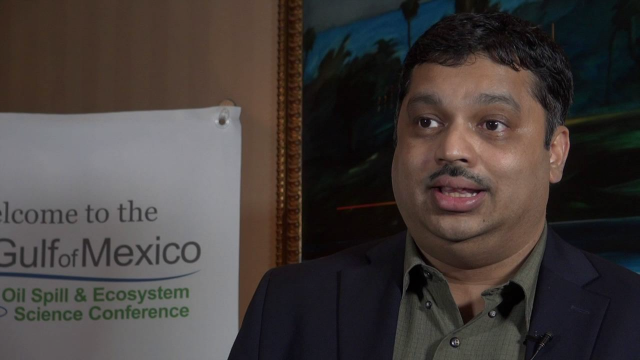
GoMRI RFP-V: Food-Grade Dispersants as Highly Efficient / Safe Materials for Oil Spills (Raghavan)
Project is lead by P.I. Srinivasa R. Raghavan, University of Maryland.
|
|
|
RECOVER Video Depicts Mahi Research Using Tags and Drifters
The short clip focuses on Ph.D. student Lela Schlenker’s work capturing Mahi, fitting them with satellite tags, and releasing them back into the Gulf alongside biodegradable drifters. While the drifters track how the fish interact with currents, the satellite tags will document their speed, depth, and location.
Meet C-IMAGE’s September Student of the Month Lindsey Dornberger
Lindsey is a marine science Ph.D. student whose research incorporates field and laboratory studies assessing the Deepwater Horizon oil spill’s impacts on Gulf organisms into the Atlantis ecosystem model. Her work will allow researchers to use the model to identify the spill’s effects on the entire ecosystem, potential indirect effects, and which ecosystem areas require further research.
ACER Series Highlights Bioturbation
The most recent “Took Talk” entry focuses on bioturbation, an important process to ocean floor health that occurs when organisms move through, ingest, and alter the characteristics of seafloor sediment.
CONCORDE Photo Shows Local Fishers Preparing for Research
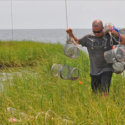
In the shot, a shrimper reviews sampling protocols for an upcoming expedition to the Mississippi Sound, where he will collect temperature and salinity depth profiles for the consortium’s field effort.
Get to Know CRGC Student Laura Edington
Laura is an economics and computer science undergraduate student at Tulane University. She is following her passion for information access and community empowerment through her CRGC work.
ECOGIG Takes “Ocean Discovery Zone” to Middle Schoolers
Consortium representatives used the Ocean Discovery Zone, an educational exhibit and hands-on activity, to teach Cowan Road Middle School students about impacts of hydrocarbons on deepwater ecosystems. Photos from the event are available here. Learn more about the Ocean Discovery Zone here.
|
|
|
|
|
|
|