|
|
|
|
June 28, 2016 GoMRI eNews
|
|
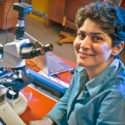
The Gulf of Mexico Research Initiative congratulates one of its own – Dr. Arezoo Motavalizadeh Ardekani, an assistant professor at Purdue University’s School of Mechanical Engineering – for receiving the prestigious Presidential Early Career Award for Scientists and Engineers (PECASE).
|
|
|
The Gulf of Mexico Research Initiative is pleased to announce a new Sea Grant informational brochure about Deepwater Horizon oil spill impacts on fisheries. This brochure synthesizes peer-reviewed oil spill science for a broad range of general audiences, particularly those who live and work across the Gulf Coast.
|
|
|
Scientists monitored a major river discharge event in Mobile Bay in March 2011 to better understand how such inputs affect Gulf of Mexico nearshore water transport.
|
|
|
Posted on June 23, 2015
Scientists from the University of Southern Mississippi and Sultan Qaboos University assessed community responses to the Deepwater Horizon oil spill using data from a long-term plankton survey off the Alabama coast.
|
|
|
Posted on June 17, 2014
GoMRI announces their Scholars Program to recognize the graduate students whose vital research contribute to improve understanding about the damage, response, and recovery following the Deepwater Horizon oil spill.
|
|
|
Posted on June 18, 2013
Oil and water don’t mix, right? For the most part, that’s true. Oil is made up of many compounds, the majority of which are not water soluble or “non-polar” in scientific terms. When oil enters water, such as from a spill, most of it gathers together in balls or sheets.
|
|
|
Posted on June 15, 2012
Salt marshes are one of the most vulnerable coastal environments in the Gulf of Mexico.
|
|
|
Study Shows Deepwater Horizon Suppressed Fiddler Crab Populations in Oiled Marshes
Deepwater Horizon Oil Spill Impacts on Salt Marsh Fiddler Crabs (Uca spp.). Zengel, S.; Pennings, S.; Silliman, B.R.; Montague, C.; Weaver, J.; Deis, D.R.; Krasnec, M.O.; Rutherford, N.; Nixon, Z. Estuaries and Coasts, 2016, 39, 4, 154–1163
Study Compares Natural Sunlight Effects on Macondo and Surrogate Oil
Photochemical changes in water accommodated fractions of MC252 and surrogate oil created during solar exposure as determined by FT-ICR MS. Vaughan, P.P.; Wilson, T.; Kamerman, R.; Hagy, M.E.; McKenna, A.; Chen, H.; Jeffrey, W.H. Marine Pollution Bulletin, 2016, 104, 262–268
|
|
|
|
GoMRI RFP-V: Deep-sea Risk Assessment & species sensitivity (Knap)
The Deep-sea Risk Assessment and species sensitivity to WAF, CEWAF and Dispersant project is lead by P.I. Anthony Hayden Knap, Texas A&M University. Although dispersant application at the sea surface has been extensively studied, more data are needed on the efficiency and environmental impacts of dispersed oil in the subsea to evaluate and document acceptability of this response technique.We will test a series of deep sea organisms to the effect of specific individual hydrocarbons, as well as WAF, CEWAF and Dispersant. If successful, we are hoping to develop a new method for the effects of contaminants on marine organisms.
|
|
Sport Fishing Magazine Features DEEPEND Research and Images
The article “25 Deep-Sea Creatures That Will Creep You Out” uses high-resolution close-ups of deep-sea organisms collected during DEEPEND cruises to highlight the diverse and often bizarre creatures the consortium’s scientists research.
CONCORDE Emphasizes Dedication to Mentoring Young Scientists
Consortium researchers are helping graduate students and postdocs take the lead in areas such as publications and research activities in support of the carefully-crafted, consortium-wide mentorship plan. The plan aims to create competent scientists with experience and expertise in their chosen field while gathering useful data.
Meet C-IMAGE Student of the Month Marcia Trillo
Marcia incorporates droplet size distribution and biodegradation rate data into current modelling systems to help improve their ability to trace and predict oil fate and expand our understanding of oil-water interactions. Learn more about her background, research, and findings here!
ECOGIG Playlist Features Campers’ Stop-Motion Videos
This entry in the Film Fridays series highlights short stop-motion clips created by students participating in the consortium’s Ocean Science Camp. Campers in the 4th – 8th grade spent the week learning about ocean ecosystems, deep ocean discovery, and ocean challenges.
CARTHE and DROPPS Scientists Team Up for UT Summer Science Program
The researchers Skyped with 3rd – 4th graders to teach them how oil spill scientists can use drift cards to see where currents may carry spilled oil. The students then designed and released their own drift cards from the University of Texas at Austin pier. Check out the photos albums here and here to learn more about the consortia’s involvement in the program!
RECOVER Clip Discusses How Oil Spills Impact Fish
The video briefly describes how oil exposure can affect a fish’s heart, senses, and swimming ability and what that could mean for its survival.
CRGC Visits Local Plants and Shipbuilders
Consortium members toured two seafood processing plants and a local shipbuilder in Bayou La Batre, Alabama, to learn more about the community and its industry. Photos from the visit can be found here!
ACER Explains Benthic Macrofauna and Their Communities
Macrofauna are invertebrates large enough to be seen with the naked eye. This entry in the Word Wednesdays series explores macrofauna living in the benthos, a community of organisms that live on, in, or near the seabed.
Get to Know CWC Scientist Paola López-Duarte
Driven by a desire to uncover new information about scientific unknowns, López-Duarte studies the Deepwater Horizon oil spill’s impacts on marsh fish communities and food webs. Find out more about her research and her experiences here!
|
|
|
|
|
|
|