|
|
|
|
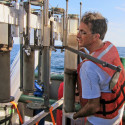
The National Oceanic and Atmospheric Administration (NOAA) and the U.S. Fish and Wildlife Service (USFWS) are making available to the scientific community Gulf of Mexico physical samples collected during and after the Deepwater Horizon oil spill. DEADLINE JUNE 10, 2016.
|
|
|
When disaster strikes, responders look at how creatures in its path may be impacted to mitigate damage. Tingting Tang takes the process one step further, using mathematical models to predict how long recovery may take. The creatures that Tingting focuses on are some of the Gulf of Mexico’s largest predators and most charismatic animals, beaked and sperm whales.
|
|
|
A team of scientists created a numerical model that simulates hydrocarbon biodegradation and transport in tidally influenced beaches to identify key factors affecting biodegradation in these environments.
|
|
|
Posted on May 26, 2015
A team of scientists from Eckerd College and University of South Florida conducted a time-series sediment study to better understand impacts from the Deepwater Horizon oil spill.
|
|
|
Posted on May 19, 2014
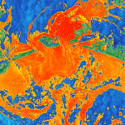
A group of scientists led by the Center for Southeastern Tropical Advanced Remote Sensing (CSTARS) of the University of Miami recently published an overview of synthetic aperture radar (SAR) as a tool to identify oil slicks on the ocean surface using satellite imagery.
|
|
|
Posted on May 17, 2013
Scientists who tracked deep underwater oil and gas plumes after the Deepwater Horizon incident concluded that the respiration of dissolved and trapped hydrocarbons resulted in reduced dissolved oxygen concentrations from a bloom of hydrocarbon-eating bacteria.
|
|
|
Posted on May 26, 2012
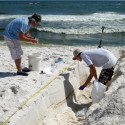
With buckets and shovels in hand, scientists have collected and are analyzing oil found in the sediments of Gulf coast beaches.
|
|
|
Study Examines Physiological Trade-Offs Associated with Toxin-Resistant Killifish
Cross-resistance in Gulf killifish (Fundulus grandis) populations resistant to dioxin-like compounds. Oziolor, E.M.; Dubansky, B.; Burggren, W.W.; Matson, C.W. Aquatic Toxicology, 2016, 175, 222-231
Study Describes ROV-Mounted Imaging System for Improved Bubble/Droplet Measurements
A deep-sea, high-speed, stereoscopic imaging system for in situ measurement of natural seep bubble and droplet characteristics. Wang, B.; Socolofsky, S.A. Deep Sea Research Part 1: Oceanographic Research Papers, 2015, 104, 134–148
|
|
|
|
GoMRI RFP-V: Role of Microbial Motility for Degradation of Dispersed Oil (Conrad)
The Role of Microbial Motility for Degradation of Dispersed Oil project is lead by P.I. Jacinta C. Conrad, University of Houston. The objective of this project is to elucidate the effects of oil-water interfaces on motility of marine bacteria in the initial stage in biodegradation, as microbes move towards and attach to dispersed oil.
|
|
June 14 Baton Rouge Sea Grant Oil Spill Seminar: Sharing Gulf Science Discoveries for Management
Presenters will discuss impacts to water resources, habitats, wildlife and fisheries, and coastal resilience. They will also talk about educational resources and access to raw data and publications. Click here to register to attend in person. Click here to register to listen online via WebEx. Note: this is a pre-conference seminar for the Gulf of Mexico Alliance (GOMA) All-Hands meeting.
June 20 Eight Mississippi Public Broadcasting Stations to Show Dispatches From the Gulf
The shows will broadcast at 9 PM (CST) on Biloxi, Booneville, Bude, Greenwood, Jackson, Meridian, Mississippi State, and Oxford stations. See the MBP TV schedule for details. Click here to request a screening near you.
June 24 Deadline to Submit a Scientific Session for the 2017 Oil Spill and Ecosystem Science Conference
View the session guidelines here. Objectives should focus on restoration and recovery, oil spill response and management strategies, human dimensions, ecological impacts, long-term fate and impacts, breakdown and transport, data management, and outreach and science communications.
Sea Grant Seeks Science Communicator at Gulf Coast Research Lab
This is a three-year, limited-term position that supports an oil spill science outreach program. Candidates must be able to serve as a science editor and writer; lead the production and printing of publications; manage and lead the oil spill team’s electronic based communications; promote team activities; provide technical support at seminars and events; and perform other duties as assigned. $45,000-$60,000 is the salary range. Click here for details or go to https://www.usm.edu/employment-hr, click “employment,” then “job opportunities.” Search for posting number 0003972.
|
|
ECOGIG Researcher Presents at White House
Principle Investigator Samantha Joye recently attended the White House Office of Science and Technology Policy’s microbiome event, where she presented the consortium’s research into microbiomes’ distribution and activity and their biogeochemical context in extreme habitats.
CARTHE Participates in Vizcaya Museum BioBlitz Event
Sponsored by National Geographic, BioBlitz events bring communities together to survey a particular area and identify as many plants and animals as possible. This year, a Vizcaya Museum and Gardens-hosted event asked CARTHE researchers to investigate the origins of the trash observed frequently collecting in the area.
C-IMAGE Researchers Teach Elementary Students about Bacteria
The scientists visited students at Laurel Ridge Elementary School that were unable to attend their class’s end-of-the-year beach trip to teach them about oil-degrading bacteria and discuss the oil spill’s impacts on beaches. Check out this photo album to learn more about the visit!
Get to Know CWC Scientist Haosheng Huang
Huang is developing numerical models that will be used to investigate the effect of wetting/drying and sedimentation/resuspension dynamics and proposed future river diversions on marsh oil transport, burial, and fate.
ACER Introduces Readers to the FlowCAM
This “Tool Talk” article discusses how a digital imaging system called the FlowCAM utilizes particle imaging and automatic pattern recognition to collect images of particles in fluid, which plankton ecologists can use to identify plankton various species and their abundance.
DEEPEND Researchers Process Specimen Post-Cruise
Although the consortium’s most recent cruise has ended, scientists are still hard at work analyzing and sampling the aquatic creatures captured at sea. Read this blog post to learn more!
DROPPS Scientists Hit the Water for Oil Spill Science Education
Researchers recently took a group of ninth grade students aboard the R/V Katy to explore oil spill science through a plankton tow, benthic mud grab, and trawl. Head to the photosets here and here to find out more about this activity.
|
|
|
|
|
|
|