|
|
|
|
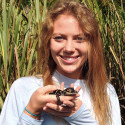
Immediately following the Deepwater Horizon oil spill, the National Center for Disaster Preparedness surveyed households in highly-affected Louisiana areas to track the event’s health and social impacts.
|
|
|
The Smithsonian posted an article about deep-sea research, using eye-popping photography to make the unreal real.
|
|
|
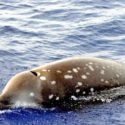
Scientists used passive acoustic monitoring during 2010-2013 to detect the presence of beaked whales in the Gulf of Mexico. These animals are difficult to study visually because they spend little time at the sea surface and are only present in offshore deep waters; they are rarely found on the continental shelf and near-shore waters.
|
|
|
Posted on May 7, 2015
Unhealthy diet and inactivity are the first things that people think about that cause obesity. However, Alexis Temkin is finding an unexpected potential contributor to increased fat cell production: a component in dispersants used for oil spill cleanup and many personal care products.
|
|
|
Posted on May 14, 2014
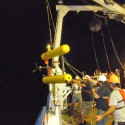
The Mola Mola, one of only six SeaBED class Autonomous Underwater Vehicles (AUVs) in the world will be in the Gulf of Mexico later this month as scientists survey the sea floor near the Macondo wellhead.
|
|
|
Posted on May 10, 2013
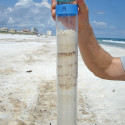
Scientists studying the fate of oil from the Deepwater Horizon incident published their findings in the November 2012 edition of Public Library of Science (PLoS ONE): Dispersants as used in response to the MC252-spill lead to higher mobility of polycyclic aromatic hydrocarbons in oil-contaminated Gulf of Mexico sand.
|
|
|
Posted on May 17, 2012
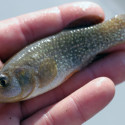
Why would scientists select a small marsh minnow to help them understand the impacts of the Deepwater Horizon oil spill?
|
|
|
Study Gives New Observations of Gulf of Mexico Shelf-Slope Exchanges
Shelf break exchange events near the DeSoto Canyon. Hamilton, P.; Speer, K.; Snyder, R.; Wienders, N.; Leben, R.R. Continental Shelf Research, 2015, 110, 25–38
Study Tests Effectiveness of Clay Nanotubes Delivery of Surfactants
Surfactant-loaded halloysite clay nanotube dispersants for crude oil spill remediation. Nyankson, E.; Owoseni, O.; John, V.T.; Gupta, R.B. Industrial & Engineering Chemistry Research, 2015, 54, 38, 9328–9341
|
|
|
|
GoMRI RFP-V: Oil-Marine Snow-Mineral Aggregate Interactions and Sedimentation (Burd)
The Oil-Marine Snow-Mineral Aggregate Interactions and Sedimentation during the 2010 Deepwater Horizon Oil Spill project is lead by P.I. Adrian Burd, University of Georgia. The goal of this project will be to use coagulation theory to develop a predictive, mechanistic model for how oil coagulates with particulate material in the marine environment.
|
|
June 14 Baton Rouge Sea Grant Oil Spill Seminar: Sharing Gulf Science Discoveries for Management
Presenters will discuss impacts to water resources, habitats, wildlife and fisheries, and coastal resilience. They will also talk about educational resources and access to raw data and publications. Click here to register to attend in person. Click here to register to listen online via WebEx. Note: this is a pre-conference seminar for the Gulf of Mexico Alliance (GOMA) All-Hands meeting.
October 20 New York Screening of Dispatches From the Gulf
The next public screening of the documentary will be at the Engelman Recital Hall, Baruch College in New York. Click here to request a screening near you.
Submit a Scientific Session for the 2017 Oil Spill and Ecosystem Science Conference
The deadline to submit a session proposal is June 24, 2016. The theme “Ecosystem Approaches to Gulf Response and Restoration” encourages the application of research results for practical use. View the guidelines here. Sessions objectives should focus on restoration and recovery, oil spill response and management strategies, human dimensions, ecological impacts, long-term fate and impacts, breakdown and transport, data management, and outreach and science communications.
Sea Grant Seeks Science Communicator at Gulf Coast Research Lab
This is a three-year, limited-term position that supports an oil spill science outreach program. Candidates must be able to serve as a science editor and writer; lead the production and printing of publications; manage and lead the oil spill team’s electronic based communications; promote team activities; provide technical support at seminars and events; and perform other duties as assigned. The annual salary range is $45,000-$60,000, depending on qualifications and experience. Click here for details or go to https://www.usm.edu/employment-hr, click “employment,” then “job opportunities.” Search for posting number 0003972.
|
|
ACER Sheds Light on Microplankton
The latest entry in the “Word Wednesdays” series discusses this class of organisms that includes both plant-like and animal-like creatures such as paramecium, amoebas, and foraminifera.
CARTHE Photos Depict Wave Tank Experiments
This photoset documents how consortium scientists are using the largest outdoor saltwater wave tank facility in North America to quantify the way drifters move with respect to oil.
C-IMAGE Recycles Test Tubes through Art
Every Gulf of Mexico marine sediment sample that consortium researcher David Hastings processes generates four plastic disposable test tubes. Because reusing these tubes could contaminate future samples, Hastings called for Eckerd students to create pieces of art from the used tubes.
CONCORDE Releases High-Resolution Photos of Tiny Organisms
The In Situ Ichthyoplankton Imaging System (ISIIS) is capable of taking super-high-resolution underwater photos of zooplankton and other miniscule marine creatures. The photos here depict a school of solmaris jellies and a close-up image of a larval lobster attached to a liriope.
CRCG Features Graduate Student Parks
Vanessa Parks received the Larry DeBord Award for Outstanding Graduate Students in Sociology for her masters work at the University of Southern Mississippi and currently studies disasters and community at Louisiana State University. You can learn more about her and her work as a CRGC research assistant here.
CWC Kicks Off Blog Series for American Wetlands Month
The consortium’s education team will release weekly blog posts highlighting wetland importance, types, functions, habitats, and the economic and social values they possess both in Louisiana and around the world. Check out the inaugural post written by Hannah Sarver, which introduces the reader to wetlands terms, facts, and figures.
LADC-GEMM Researcher Assists ROV Competition
Alex Turpin of NOAA recently supervised Team Finnovators of Newport High School, whose innovative ROV designed to collect oil samples and cap wells at sea received top honors in the Regional MATE competition. The team will advance to the 15 thAnnual International MATE ROV Competition and is considering using summer internships at Newport’s Hatfield Marine Science Center to make improvements to the model SeaGliders to be used in future STEM activities.
RECOVER Clip Depicts Mahi Tagging
The short clip shows how researchers at the University of Miami satellite tag adult Mahi. These tags will help researchers determine if their experiments could be replicated in the wild.
|
|
|
|
|
|
|