|
|
|
|
November 3, 2015 GoMRI eNews
|
|
Jarrett Cruz has been all over the world studying nannoplankton, a marine species he did not know existed when his journey began. Jarrett’s research into these minuscule creatures spans both biology and geology as he studies the impact of oil on nannoplankton that live in the Gulf of Mexico.
|
|
|
Scientists analyzed microbial communities on beaches oiled by the Deepwater Horizon spill and found taxonomic and functional changes after hydrocarbon exposure.
|
|
|
Scientists conducted experiments to determine the effects of hypoxia (reduced oxygen conditions), a seasonal occurrence in the northern Gulf of Mexico, and oil spill contaminants on sheepshead minnow larvae.
|
|
|
Posted on October 28, 2014
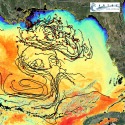
Scientists measured the speed of small, short-lived Gulf surface currents using position data from nearly 300 drifters to determine surface current impact on the dispersion of ocean contaminants.
|
|
|
Posted on October 30, 2013
Many people outside of the Gulf Coast region are not aware of the large population of Vietnamese residents who live across this area, in concentrated communities from Texas to Alabama.
|
|
|
Posted on November 8, 2012
“Highly successful” is how Chief Scientist Ian MacDonald described his recent research cruise on the RV Weatherbird II to identify natural oil seeps to use as control sites as part of a larger effort to study the effects of oil and gas in the deep sea environment.
|
|
|
Study Describes Vulnerability of Marine Plants in Oiled Sediments
Study: Resuspension of Oil-Enriched Organic Matter Could Effect Microbial Food Web
Enhanced particle fluxes and heterotrophic bacterial activities in Gulf of Mexico bottom waters following storm-induced sediment resuspension. Ziervogel, K.; Dike, C.; Asper, V.; Montoya, J.; Battles, J.; D'souza, N.; Passow, U.; Diercks, A.; Esch, M.; Joye, S.; Dewald, C.; Arnosti, C. Deep Sea Research Part II: Topical Studies in Oceanography, doi:10.1016/j.dsr2.2015.06.017.
|
|
CARTHE Engages Students in Drift Card Experiment
Researchers discussed the upcoming Lagrangian Submesoscale Experiment (LASER) in high school classrooms that will design their own drifters and help paint CARTHE’s new cost-efficient, biodegradable drift cards. Learn more through this photo album and watch testing for the new drift cards in this video.
Glider Deployment Jump Starts CONCORDE Research Effort
The underwater robot will spend over two months monitoring metrics such as temperature and salinity as part of the consortium’s fall research campaign. The project will explore northern Gulf water movements and marine life distributions to assess how future oil spills might impact the area.
ECOGIG Releases Striking Photograph of Natural Oil Seep
The image, taken by human-occupied vehicle (HOV) Alvin, shows oil and gas rising from a natural seep in the Gulf of Mexico seafloor.
CWC Researcher Named Explorers Club Fellow
The Explorer’s Club is an international professional society aimed at promoting research and the instinct to explore. Dr. Annette Engel was selected due to her research in alligator-filled salt marshes and deep underground cave systems.
DEEPEND Lesson Plans and Activities Available Online
The free, downloadable classroom materials cover topics ranging from bioluminescence to hydrothermal vent food webs and include curricula, experiment instructions, and coloring sheets!
RECOVER Completes Fishing Expedition
Scientists and professional anglers captured wild mahi-mahi broodstock (breeding adults) for their research examining the impacts of crude oil on mahi-mahi and red drum. The project will use unique maturation tanks that allow the fish to spawn in captivity year-round.
|
|
|
|
|
|
|